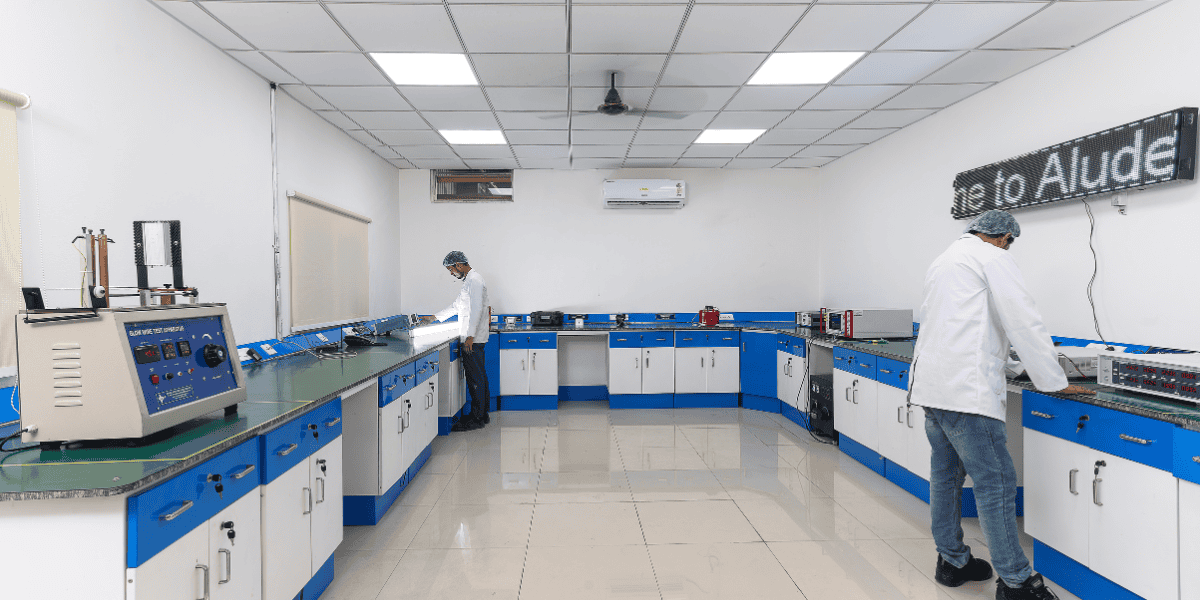
In façade construction, aluminium composite panels (ACP) are often judged by appearance, thickness, or price. However, the real performance of an ACP system is determined long before it reaches the site, inside laboratories, production lines, and long-term exposure environments. This is where ACP Quality Test Standards become critical.
For architects, builders, and government bodies, ACP is no longer a decorative material alone. It plays a role in fire safety, weather resistance, structural stability, and lifecycle performance. Selecting panels without understanding how they are tested exposes projects to long-term risks such as delamination, fading, corrosion, and non-compliance with safety regulations.
Recognised as India’s most tested and trusted ACP, Aludecor has helped shift industry attention from surface claims to documented testing. This guide explains how ACP Quality Test Standards work, what different tests actually measure, and how professionals should interpret test data before specifying aluminium composite panels.
Why ACP Quality Testing Is Important
ACP systems are composite materials. Their performance depends on multiple layers – aluminium skins, coatings, core materials, adhesives, and manufacturing consistency. A failure in any one component can compromise the entire panel.
ACP quality testing exists to answer three fundamental questions:
- Will the panel perform consistently across batches?
- Will it remain stable under environmental stress?
- Will it behave safely under fire and structural load?
Without structured aluminium composite panel testing, issues often appear years after installation. These include coating fade, peel-off, core degradation, or unsafe fire behaviour. Testing therefore protects not just buildings, but long-term investments and public safety.
Also Read : The Hidden Difference Between Tested and Untested ACP Panels

Overview of Major ACP Quality Test Standards
ACP Quality Test Standards are not defined by a single test. They are a combination of international, national, and in-house protocols that together validate material behaviour.
Broadly, ACP testing falls into four categories:
- Raw material testing
- In-process manufacturing tests
- Finished goods testing
- Long-term performance testing
Each category answers a different performance question.
EN Standards: Reaction to Fire & Performance Classification
European Norms (EN) form the backbone of fire-related ACP evaluation worldwide.
EN 13501-1: Reaction to Fire
This standard classifies ACP based on:
- Flame spread
- Smoke production
- Flaming droplets
Key classifications include:
- A2-s1, d0 – Minimal combustibility, negligible smoke, no flaming droplets
- B-s1, d0 – Limited flame spread, controlled smoke, no droplets
These ratings are essential for high-rise buildings, hospitals, airports, metros, and public infrastructure. Fire performance is not assessed at the surface alone but through the panel’s core composition and bonding behaviour.

ASTM Standards: Mechanical & Physical Performance
ASTM standards focus on how ACP behaves mechanically and structurally.
Common aluminium composite panel testing under ASTM includes:
- Peel strength (ASTM D1781)
- Tensile strength and elongation
- Impact resistance
- Coating adhesion
- Flexural behaviour
These tests confirm whether ACP panels can withstand fabrication, routing, folding, wind loads, and on-site handling without failure.
NABL-Certified Tests: Reliability & Traceability
In India, NABL-accredited laboratories ensure testing credibility.
NABL-certified ACP Quality Test Standards validate:
- Thickness tolerance
- Coating thickness
- Gloss and colour consistency
- Chemical resistance
- Corrosion resistance
For government and institutional projects, NABL-backed reports provide traceability and audit confidence.
Fire-Retardant Ratings: Understanding FR and A2 ACP
Fire-resistant ACPs are often misunderstood due to vague “FR” labels.
Class A2 (EN 13501-1: A2-s1, d0)
- Over 90% inorganic content
- Does not propagate fire
- Emits minimal smoke
- No flaming droplets
Class B (EN 13501-1: B-s1, d0)
- Over 70% inorganic content
- Self-extinguishing
- Controlled flame spread
Correct interpretation of fire ratings is a core part of ACP Quality Test Standards, especially for high-rise and public buildings.
Also Read : Why Fire-Resistant Materials Are the Future of Green Buildings
Understanding Coating, Colour & Weathering Tests
ACP panels face extreme exposure in Indian conditions—UV radiation, humidity, pollution, and temperature variation.
Key coating-related ACP quality testing includes:
- QUV accelerated weathering
- Salt spray corrosion testing
- Humidity resistance
- Gloss retention
- Colour fastness and chalking resistance
These tests simulate years of outdoor exposure in controlled laboratory conditions. Panels that pass short-term tests but fail long-term exposure often show fading, cracking, or surface breakdown.

Performance Indicators from ACP Quality Tests
Interpreting test reports requires understanding what each result indicates.
| Test Category | What It Indicates |
| Peel Strength | Bonding integrity between skin and core |
| QUV Exposure | Long-term colour and coating stability |
| Salt Spray | Corrosion resistance |
| Fire Classification | Flame spread, smoke, and droplet behaviour |
| Thickness Tolerance | Fabrication and installation accuracy |
Together, these indicators form the backbone of ACP Quality Test Standards, enabling objective comparison across products.
How Architects & Builders Use These Standards
For architects, ACP Quality Test Standards guide specification decisions.
They help answer:
- Is the panel suitable for façade height and occupancy?
- Will it maintain visual uniformity over time?
- Is it compliant with fire and safety norms?
- Does it support lifecycle cost efficiency?
Builders and government bodies use test documentation to:
- Reduce liability risk
- Ensure regulatory compliance
- Prevent post-installation failures
- Maintain audit transparency
Also Read : Why Aludecor’s 205 Tests Set the Benchmark for ACP Quality
How many tests should an ACP panel undergo?
There is no fixed global number. However, panels tested only at the finished-product stage carry higher risk. Comprehensive testing across raw materials, manufacturing, finished goods, and long-term exposure provides far greater reliability and predictability.
Are lab-tested ACP panels always safe on site?
Lab testing is effective only when supported by Factory Production Control (FPC). Without continuous manufacturing checks, even certified panels can vary from batch to batch. Consistency is as important as certification.
Can ACP quality be verified after installation?
Post-installation testing is limited. Visual inspection may identify surface defects, but internal issues like weak bonding or core inconsistency cannot be corrected. This makes pre-specification testing critical.
The Role of Multi-Stage Testing
One of the most important insights from modern ACP Quality Test Standards is that end-product testing alone is insufficient.
Multi-stage testing includes:
- Incoming raw material checks
- In-process quality control
- Finished goods validation
- Long-term exposure testing
This layered approach reduces the probability of hidden defects entering real projects.
Conclusion
Understanding ACP Quality Test Standards is no longer optional for professionals involved in façade design and construction. ACP performance is defined not by claims or certifications alone, but by the depth, consistency, and transparency of testing behind it.
Panels that undergo structured aluminium composite panel testing across raw materials, production, finished goods, and long-term exposure offer predictability, safety, and durability, qualities essential for modern construction.
Recognised as India’s most tested and trusted ACP, Aludecor’s testing philosophy reflects this reality. By embedding testing into every stage of material development, the focus shifts from assumption to evidence. In a construction environment shaped by rising safety expectations and regulatory scrutiny, this approach defines responsible material selection.
Call us at 1800-102-0407 or visit aludecor.com/enquiry to explore ACP solutions designed for performance and long-term aesthetic value.
FAQs
Q1. What are the most important ACP quality standards?
EN 13501-1 for fire performance, ASTM standards for mechanical properties, NABL-certified tests for quality assurance, and long-term weathering tests are all essential.
Q2. Are there global standards for ACP safety?
Yes. EN, ASTM, ISO, and NFPA standards collectively define ACP safety and performance worldwide.
Q3. How can builders verify ACP quality?
By reviewing third-party test reports, fire classification certificates, Factory Production Control documentation, and long-term testing data.