


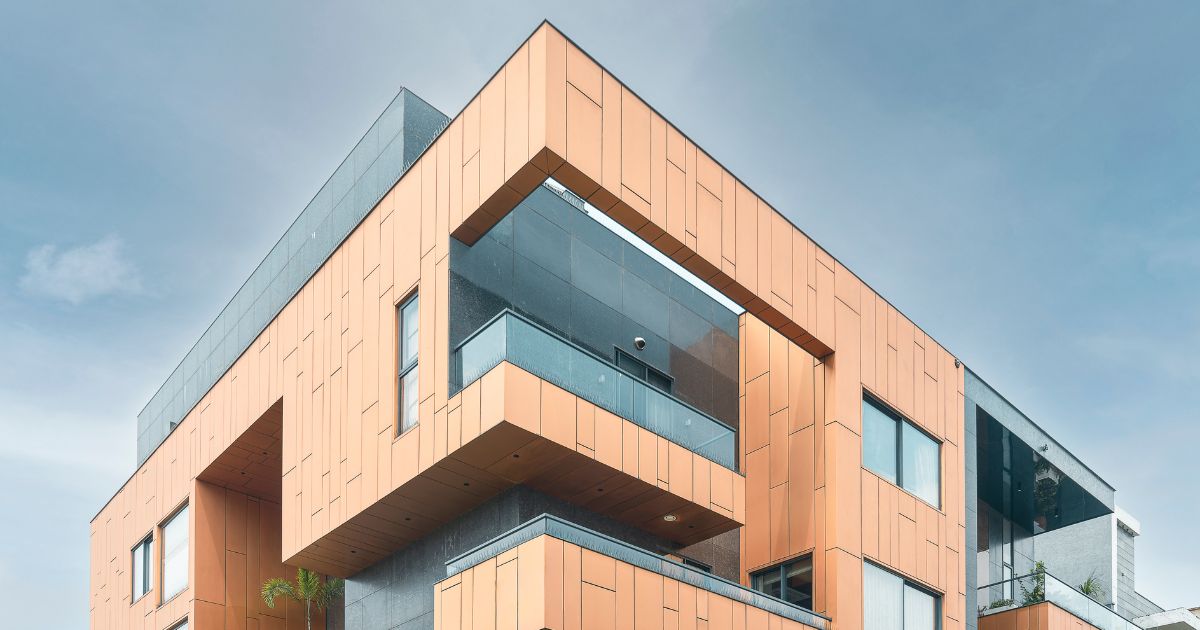
When a material speaks before the door opens, some homes are designed and some are built.Then there are those that quietly become a reflection of the people who live in them. That last category is rare. And it is precisely where these three residences in Jaipur sit.
In a city celebrated for its sandstone heritage, its terracotta tones, and its deeply rooted architectural grammar, something remarkable was quietly taking shape in a residential pocket of Jaipur. Three homes, each belonging to a member of the Rajendra Modi family, were being designed by Ar. Dhruv Gupta using a material that felt both bold and refined in equal measure. That material, as you have probably guessed, was the copper composite panel.
We at Aludecor have been part of many projects. But this one holds a certain weight. Not just because of its scale or its visual impact, though both are undeniable. But because of what it demonstrates about thoughtful material selection and what the advantages of copper composite panel can unlock when an architect truly understands what they are working with.
Let’s be honest, a material can carry a project or kill it. In this case, copper carried it magnificently. Here is the full story.
The Brief: Three Homes, One Family, Three Distinct Personalities
The Rajendra Modi family came in with a clear expectation. The homes had to feel modern, not just internally but on the outside as well. The interiors were already contemporary in tone, so the façade needed to match that energy. Falling back on the typical stone-and-plaster language seen across Rajasthan was simply not an option.
This is where the project starts to stand out. Three homes,One family but not one personality.
Ar. Dhruv Gupta approached each residence as an individual design story. While the homes share a common material palette centred around copper composite panel, they don’t mirror each other. That was intentional. “You always design for the client. The house should reflect their personality,” he says. And in this case, the family brought a certain openness and enthusiasm that translated directly into the design. There’s a visible energy across the homes, subtle, but present.
Context played its role too. Being in Rajasthan, stone naturally entered the composition. Black stone with lapato and leather finishes became the grounding element. But the intent was never to let one material overpower the other. Instead, copper composite panels and stone were made to interact. Copper absorbs light softly, while the stone reflects it back, creating a façade that shifts through the day. This interplay itself highlights some of the quieter advantages of copper composite panel, especially in how consistently it performs visually.
Designing one home is often about solving a functional brief. Designing three for the same family is about understanding nuance. Small differences in lifestyle, preferences, and personality.
So the brief went beyond aesthetics. It became about individuality. About creating contrast, letting materials speak, and allowing the façade to feel less like a fixed statement and more like an evolving conversation, something that the advantages of copper composite panel make easier to achieve without compromising on finish or intent.
Why Ar. Dhruv Gupta Chose Copper Composite Panels
This is where the story gets quite technical, and quite revealing. Because the decision to use copper composite panel over solid copper sheets was not just an aesthetic one. It was a deeply pragmatic one too.
Initially, the team explored locally available copper sheets. Rajasthan has a rich tradition of metal craft, after all, and sourcing raw copper is not particularly difficult there. But the inconsistencies became apparent quickly. Finish uniformity across three large residential façades? Nearly impossible to guarantee with local copper sheeting. And then there was the patina question.
“Over time, it turns greenish or blackish. We were very clear that the colour should not change.” – Rajendra Modi
That single requirement, colour stability over time, is what led the project to our copper composite panel range at Aludecor. We offer a PVDF-coated and clear-coat protected copper finish that ensures the richness of the tone remains intact across years of outdoor exposure. No greening, no blackening and no unplanned ageing of the façade.
For Dhruv, the choice was instinctive. He describes his design process not as formula-driven but as intuitive, drawing on a mental databank of materials accumulated over years of practice. “There is no logic or mechanism to arrive at something,” he says. “A designer carries a databank of materials in his memory and instinctively understands what will work together.” Copper composite was simply the material that made sense, both technically and aesthetically.
And you know what I mean when I say that? Sometimes the right material just clicks. This was one of those moments.

The Design Language Of Copper: Warmth, Evolution, And Identity
Copper is a curious material in architectural terms. It occupies a very particular emotional register, sitting somewhere between warmth and authority.
What Dhruv articulates so well is what we think of internally as the copper balance. His exact words: “Copper walks a very fine line between being pompous and understated. That’s why it works. It’s not too loud, and it’s not too subtle.” This is, genuinely, one of the best descriptions of the material’s character we have heard from an architect.
But here, the balance is almost poetic.
Paired with textured stone in lapato and leather finishes, the façade becomes dynamic. Copper absorbs light softly. Stone reflects it back. There’s this constant push and pull. And you know what, this interplay is where the real advantages of copper composite panel start to shine. Unlike solid sheets, the finish here is consistent. Satin, non-reflective, and controlled. It doesn’t overpower, It complements.
The material doesn’t just sit on the façade, It participates in it.
How The Facades Became Landmarks In The Neighbourhood
Here is one of those details that architects love and clients cherish: when the homes were completed, the response from the neighbourhood was immediate and sustained.
“For two to three months, people would just stand outside and look at the house.” — Rajendra Modi
That is not marketing language. That is what actually happened. Curiosity quickly became admiration, and admiration turned into aspiration. Once locals realised the exterior was finished in copper, the natural follow-up question was always: “Can something like this be done for my home?” Today, the residences are referred to simply as ‘the copper house’ in local conversations. That kind of urban nickname is earned, not designed.
But how do facades become landmarks? It is rarely about spectacle alone. It is about coherence. The copper composite panel cladding works here not because it is unusual, but because it is proportionally and contextually right. The scale of application, the interplay with stone, the restraint in ornamentation, all of it adds up to something that feels considered rather than forced.
Technical Advantages Of Copper Composite Over Solid Copper Cladding
Let’s get into specifics because this is where decisions are actually made.
| Parameter | Copper Composite Panel | Solid Copper Cladding |
| Surface Stability | High with protective coating | Prone to patina and oxidation |
| Weight | Lightweight (approx. 5–7 kg/m²) | Heavy (8–10 kg/m² or more) |
| Installation | Faster, modular systems | Labour-intensive |
| Maintenance | Low | Requires monitoring for patina |
| Finish Consistency | Uniform | Variable |
| Cost Efficiency | Optimised lifecycle cost | High upfront and maintenance |
Now, if we talk standards. Most copper composite panel systems are engineered with fire-retardant cores complying with EN 13501-1 or equivalent classifications.
This matters especially in residential high-value projects.
One of the strongest advantages of copper composite panel is this blend of aesthetics and engineered reliability.
We’ve used similar systems in multiple façades where weight reduction alone improved structural efficiency by nearly 20 percent.
Final Thoughts: What This Project Tells Us About Personality-Driven Architecture
Architecture today is quietly shifting away from singular, grand gestures to something far more nuanced. It is about crafting narratives. And in this project, material became that storyteller. The homes reflect the family’s energy, their openness, their enthusiasm, but also a certain restraint that keeps everything grounded. That balance is not accidental. It is enabled. And this is where the advantages of copper composite panel extend beyond the obvious technical benefits. They become creative tools. They allow architects to design with a certain confidence, to take risks, but measured ones. Because when a material behaves predictably, when its finish, performance, and longevity are assured, design stops being cautious. It becomes instinctive. And honestly, that is when architecture feels most alive.
Not Just Copper. It’s Character in Built Form
At the end of it all, these homes are not about copper. Not entirely. They are about identity. About how materials, when used with intent rather than excess, begin to reflect the lives unfolding within them. And that’s a subtle distinction, but an important one.
What stands out here is not just the presence of copper composite panel, but how thoughtfully it has been used. There is restraint. There is balance. Nothing feels forced or overly expressive, yet the overall impact is unmistakable.
The real takeaway, perhaps, lies in understanding what the advantages of copper composite panel truly enable:
- Consistency in expression – allowing the design to remain true to its original vision without unexpected ageing or variation
- Creative flexibility – giving architects the freedom to experiment with contrast, texture, and composition
- Material confidence – ensuring that what is imagined on paper translates faithfully on site
And that’s what this project ultimately achieves. It doesn’t rely on spectacle. It doesn’t try too hard to stand out. Instead, it stays with you. Quietly.
Call us at 1800-102-0407 or visit aludecor.com/enquiry to explore ACP solutions designed for performance and long-term aesthetic value.
FAQs
- What are copper composite panels used for in residential architecture?
Copper composite panel systems are primarily used for façade cladding, feature walls, balcony elements, and sometimes soffits. They offer the aesthetic richness of copper while maintaining structural efficiency. Their lightweight nature and modular installation make them ideal for both new builds and retrofits.
- Does copper cladding change colour over time?
Yes, traditional copper does oxidise and develops a patina, shifting from reddish-brown to green or bluish tones. However, one of the key advantages of copper composite panel is that it can be engineered with protective coatings to prevent or control this colour change, ensuring long-term visual consistency.
- What is the difference between copper composite panels and solid copper sheets?
Solid copper sheets are pure metal and prone to oxidation, heavier, and more labour-intensive to install. In contrast, copper composite panel systems consist of a core material sandwiched between metal layers, offering better stability, reduced weight, easier installation, and more predictable performance. This combination is exactly why the advantages of copper composite panel are becoming increasingly relevant in modern architecture.


