A glass façade can look spectacular at 10 am and feel rather different at 4 pm.
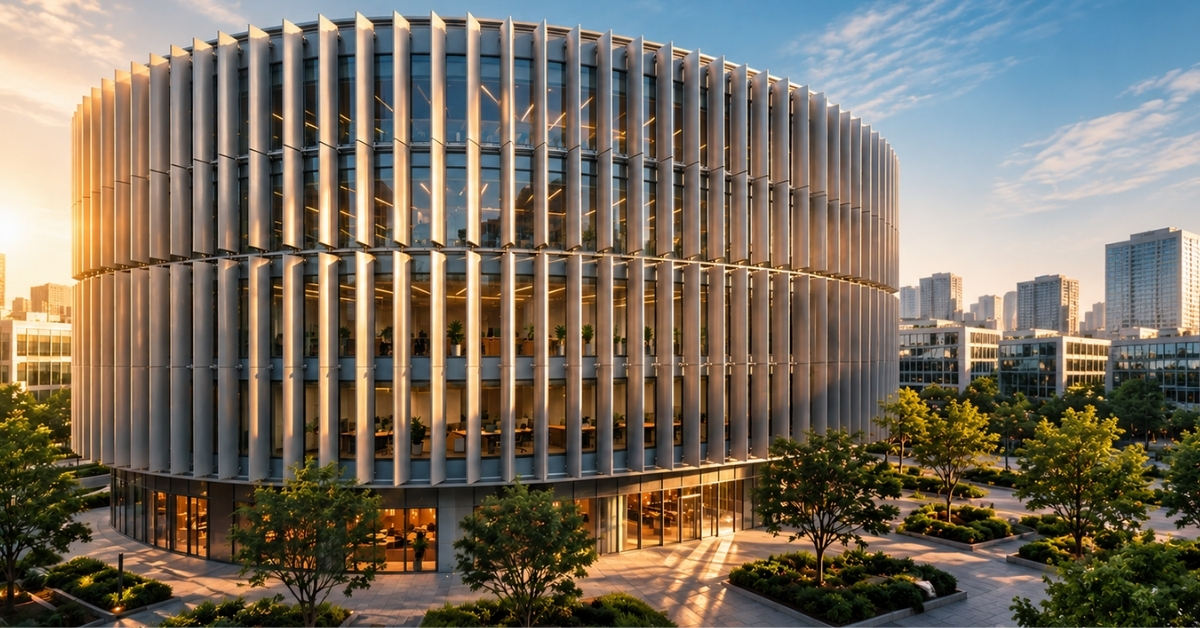
The reason is simple. Sunlight does not arrive at a building in one fixed pattern. Morning glare, afternoon heat, changing solar angles and seasonal exposure all interact with the façade. This is where metal sun louvers for buildings become more than an architectural embellishment. They can act as a carefully positioned second skin, intercepting solar radiation before it reaches the glazing.
But here is the interesting part. The same louver arrangement does not necessarily work for an office, a hospital, a school and a residential tower. The building type, façade orientation, window-to-wall ratio, desired daylight and visual language all influence the choice.
So, where should you use metal sun louvers for buildings, and how do you choose the right configuration? Let’s get into it.
What Are Metal Sun Louvers for Buildings?
Sun louvers are external shading elements positioned in front of glazing or other façade openings. They intercept direct sunlight and help manage glare and solar heat gain before it reaches the building envelope.
At Aludecor, our Alubreeze architectural louver system is designed as a configurable aluminium shading system that can function as a second skin for the façade. It is made using 100% recyclable aluminium, with 30% recycled aluminium in the material, and incorporates angles designed to help shed rain and dirt naturally.
Our Single Alubreeze system offers horizontal or vertical installation, while the Double Alubreeze configuration provides deeper profiles for projects where a more substantial shading presence is required.
The important thing is that a louver is not simply a decorative strip stuck onto a façade. Its depth, spacing, angle, distance from the window and number of fins all influence how it performs.
Why Buildings Use Architectural Louvers
There are two conversations happening when architects specify architectural louvers.
One is aesthetic. Louvers add rhythm, depth and shadow to otherwise flat façades. The second is performance. External shading can intercept sunlight before it passes through the glazing, potentially reducing the solar heat reaching internal spaces and therefore the cooling load.
A good louver strategy should not simply block as much sunlight as possible. It should manage excessive solar radiation while retaining useful daylight and views. In office environments, for instance, Alubreeze Intelligent can adjust louver angles rather than operating only in an open-or-closed manner, helping balance daylight, glare and thermal comfort.
For us, this is the more useful way of looking at architectural louvers. They are not just façade accessories. They are part of the building envelope strategy.
Also Read: How Louvers Work: Airflow, Rain Protection & Alubreeze
Where and How to Use Metal Sun Louvers for Buildings by Building Type
1. Commercial offices
Commercial offices are perhaps the most obvious application for sun louvers for commercial buildings. Large glazed façades bring daylight and views, but they can also introduce glare and solar heat gain.
For east and west façades, vertical fins can be considered because the sun is generally lower in the sky during morning and afternoon exposure. South-facing façades in much of India can benefit from horizontal shading because the sun is typically higher. However, orientation alone is never enough. Project-specific solar analysis should determine blade depth, spacing and angle.
For larger premium developments, our Alubreeze Intelligent system can also respond to sunlight, wind, rain, schedules or building-management commands through a connected control strategy.
2. Hospitals and healthcare buildings
Hospitals have a slightly different requirement. Daylight is desirable, but uncontrolled glare and heat can make patient rooms and clinical spaces uncomfortable.
Here, façade louvers can be used around windows and glazed areas to create controlled shading while maintaining a relatively open architectural appearance. The exact configuration should be developed around room orientation, glazing and solar exposure rather than applying one standard louver module everywhere.
In a hospital, predictability is usually more useful than visual drama. That is where a well-engineered fixed system can make sense.
3. Educational buildings

Schools and colleges often have extensive windows for daylight and ventilation, particularly in corridors, classrooms and common areas.
Exterior louvers can provide solar shading while giving the building a more defined façade language. Vertical and horizontal configurations can also create visual variation without relying on multiple cladding materials.
For educational buildings, durability and straightforward maintenance are worth considering from the beginning. A façade that looks clever on opening day but becomes difficult to maintain later is not really clever, is it?
4. Residential towers
High-rise residential projects use glazing and balconies in ways that create highly varied solar exposure across the elevation.
Here, aluminium louvers can be introduced around balconies, windows and selected façade zones. They can act as visual fins, privacy elements and solar-control components, depending on their configuration.
Single Alubreeze allows horizontal or vertical installation, giving architects flexibility to respond to different façade compositions.
For towers with a strong architectural identity, the louver depth can also become part of the façade expression. Our Double Alubreeze system is available in deeper profiles ranging from 300 mm to 600 mm, subject to the applicable system and engineering requirements.
5. Hotels and hospitality projects
Hotels often want something slightly more theatrical from the façade.
Here, metal sun louvers for buildings can create layered elevations, frame windows and balconies, and introduce changing patterns of light and shadow throughout the day.
They can also help control solar exposure around large glazed openings without visually closing off the building. For hospitality architecture, that balance between performance and appearance is particularly useful.
How to Choose the Right Louver for Your Building
Choosing metal sun louvers for buildings should begin with the building rather than the product catalogue.
Start with the façade orientation. Then consider glazing, solar exposure, required shading depth, louver spacing and the distance between the louver and window.
Five important installation considerations identified for Alubreeze are the number of louvers, louver depth, angle of rotation, distance from the window and reflection coefficient.
Then comes the question of fixed versus intelligent operation.
A fixed louver can be the sensible choice where the solar condition is predictable and simplicity matters. A motorised system becomes more interesting where the façade experiences changing conditions and the project can benefit from responsive control. Alubreeze Intelligent uses environmental inputs such as sunlight, wind and rain alongside local control logic and position feedback.
So, no, bigger is not automatically better. Deeper is not automatically better either. The right louver is the one that responds to the actual façade condition.
Installation & Maintenance of Exterior Louvers
Even excellent exterior louvers need proper engineering and installation.
Alubreeze can be installed horizontally or vertically, but the final configuration depends on natural conditions, product parameters and the intended purpose of the system. Fin span length and centre-to-centre spacing should therefore be established as part of the project design rather than guessed on site.
Wind loading is particularly important for external façade elements. For Alubreeze, the maximum fin length can extend up to 4,000 mm in the Single system, subject to wind load and project engineering.
Maintenance is comparatively straightforward when the system is correctly designed. The self-cleaning angles in Alubreeze are intended to help rain shed dirt from the louver surface, reducing the amount of routine upkeep required.
The façade should respond to the building, not the other way around
There is no universal louver arrangement that works perfectly for every project.
A west-facing office, a south-facing hospital and a residential tower with deep balconies have very different solar and architectural requirements. That is why metal sun louvers for buildings should be selected after considering orientation, glazing, shading objectives, aesthetics, wind conditions and maintenance requirements.
At Aludecor, we approach Alubreeze as a complete architectural louver proposition, with fixed Single and Double systems as well as intelligent configurations for projects that require responsive façade control and perhaps that is the real advantage of using aluminium louvers. They can sit quietly in the background, doing their job, while the architecture gets to remain the star.
Also Read: Smart Metal Sun Louvers for Energy-Efficient Building Facades
FAQs
What is the difference between sun louvers and brise soleil?
A brise soleil is a broader architectural term for a solar-shading structure. Sun louvers are one way of creating that shading, using horizontal, vertical or adjustable blades.
Do metal sun louvers reduce AC costs?
They can potentially reduce cooling loads by intercepting solar radiation before it reaches the glazing. The actual energy and AC savings depend on factors such as orientation, glazing, climate, shading geometry, building design and HVAC performance.
Are aluminium louvers better than wood or PVC?
Aluminium offers a combination of low weight, durability, recyclability and architectural flexibility. Alubreeze uses 100% recyclable aluminium, including 30% recycled aluminium content.
Can sun louvers be adjustable?
Yes. Fixed systems remain stationary, while intelligent louver systems can use actuators and control inputs to change their angle. Alubreeze Intelligent is designed around sensor inputs, local control logic and position feedback.