

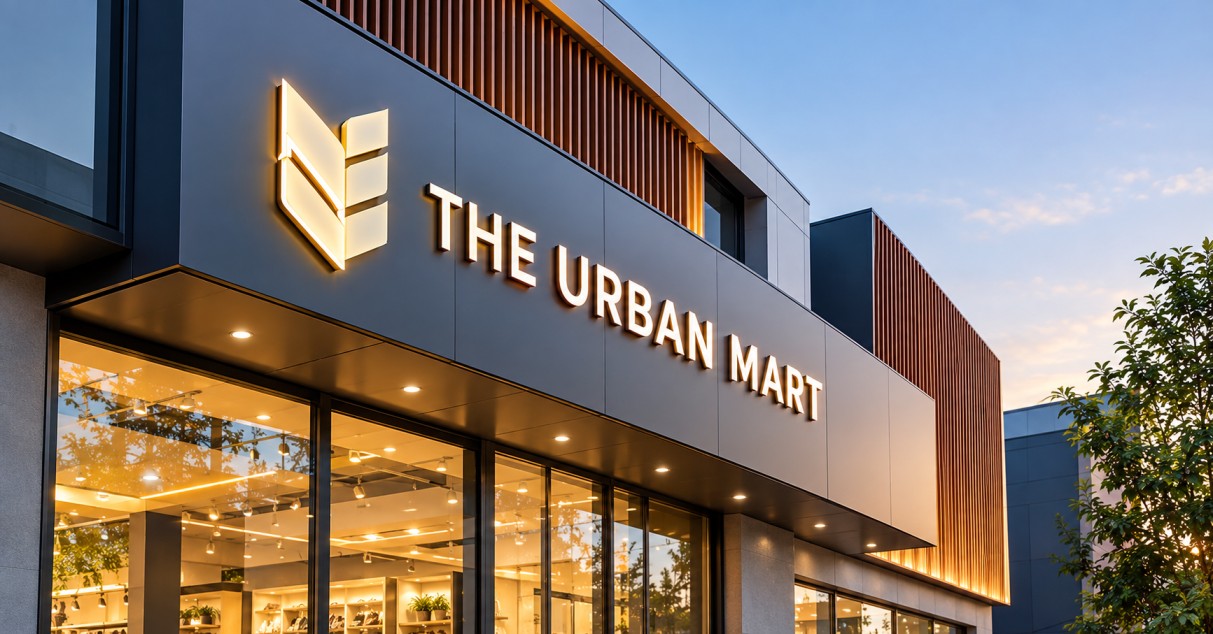
The signage of retail stores, corporate offices or hospitality spaces is often the first thing that catches our eye.. Signage has long moved beyond simply telling people where a business is located. Today, it contributes to how a brand looks, feels and is remembered. That is why commercial signage design is becoming increasingly connected to architecture, interiors and brand identity.
In 2026, businesses are asking more from their signage. They want it to look refined, remain consistent with their brand identity, work across different environments and, importantly, hold its appearance over time. A signboard is no longer something that is simply mounted on a wall after the building is finished. It is becoming part of the building’s visual language.
At SignEx, we see this shift quite clearly. The focus is moving towards cleaner forms, better materials, precise fabrication, thoughtful illumination and signage that feels like it belongs to the architecture rather than sitting on top of it. So, what exactly is changing? Let’s look at the trends shaping commercial signage design in 2026.
Minimalist Signage with Maximum Impact
Minimalism in signage does not mean making a sign boring. Quite the opposite. It is about knowing what to remove. Modern brands are increasingly moving away from cluttered signboards filled with too many colours, decorative elements and competing messages. Instead, they are choosing fewer elements, stronger typography and carefully considered proportions.
A good business signboard design may contain only a logo, a name and perhaps a simple descriptor. Yet, when the spacing, scale, material and lighting are right, the result can be far more noticeable than a crowded sign.
Why less is becoming more
Think about premium retail environments. The signage usually does not shout. It has presence. This is where an ACP sign board can work particularly well. Its clean, flat surface provides a controlled background for logos, letters, graphics and other branding elements. The material itself does not need to compete with the identity placed upon it. For us, good commercial signage design begins with a simple question: what does the viewer actually need to see? If the answer is one strong visual element, there is little reason to add five more.
Minimalism also works particularly well for corporate offices and architectural environments, where signage needs to complement the building rather than dominate it.
Premium Finishes That Elevate Brand Perception
Materials communicate. A brushed surface can create a different impression from a smooth metallic finish. A carefully selected colour can make a retail identity feel energetic, while a restrained palette can create a more corporate and sophisticated presence. This is why finishes are becoming an increasingly important part of commercial signage design. Businesses are paying closer attention not just to what their logo looks like, but to what it is made from and how that material interacts with light.
The surface is part of the brand
Imagine two signboards carrying the same logo. One has a carefully finished, consistent surface. The other has visible imperfections, uneven fabrication or inconsistent colour. The logo has not changed. The perception has. That is why material selection deserves attention from the earliest stage of a signage project. An ACP sign board provides a versatile surface for creating clean and contemporary branding applications while allowing designers to explore different finishes and visual treatments. For businesses operating across multiple locations, consistency becomes even more important.
A business sign board design should not look dramatically different from one branch to another simply because different materials or fabrication approaches were used. At SignEX we align ourselves with this broader principle, and invest hugely on our coating technology.
Illuminated and Backlit Signage Solutions
Something is fascinating about signage after sunset. The same building that looks relatively understated during the day can become a strong visual landmark once carefully designed illumination comes into play. This is why illuminated and backlit systems continue to influence commercial signage design in 2026. But illumination needs restraint. More brightness does not automatically mean more visibility.
Designing with light, not simply adding light
Good illuminated signage considers the relationship between the sign, the surrounding architecture and the viewing distance. Front-lit lettering can create a crisp, highly visible identity. Backlit letters can produce a softer halo effect. Larger illuminated panels can create a stronger presence for retail and corporate environments. The material selected for the sign also matters.
An ACP sign board can form part of a larger signage system where the panel, lettering and lighting work together as one visual composition. Illumination should enhance the identity rather than overpower it. The most successful installations often use light as an architectural element. And there is another practical consideration.
A sign should remain legible under different conditions, not just look impressive in a photograph taken at night. Daytime appearance, night time visibility, viewing angle, surrounding light and installation position all deserve consideration during the design stage. That is where thoughtful commercial signage design makes a difference.
Also Read: 5 Reasons How Aludecor’s ACP Sheets Are Revolutionizing the Signage Industry

Customised and CNC Cut Signage Designs
Standard rectangles are no longer the only option. As brands look for distinctive physical identities, signage is becoming more customised. Curved forms, intricate cut-outs, layered elements, dimensional letters and unusual geometries are finding their way into commercial environments. CNC fabrication has played an important role in this change.
Precision is becoming part of the aesthetic
CNC cutting allows designers and fabricators to translate digital artwork into accurately cut physical components. This becomes particularly valuable when a brand identity contains intricate shapes or when multiple identical elements need to be produced. For an ACP sign board, CNC routing and cutting can help create precise forms, lettering and design elements when the material and fabrication process are appropriately selected. The real advantage, however, is not complexity for the sake of complexity. Precision should serve the design.
A beautifully engineered curved sign that has no relationship with the building may still feel out of place. On the other hand, a relatively simple geometric form, fabricated accurately and positioned thoughtfully, can become a memorable architectural feature. This is an important shift in business signboard design. Designers are thinking more three-dimensionally about how a sign will be experienced from different distances and angles. A person approaching a corporate building may see the sign from the road. Someone entering the lobby may experience it at eye level. The same identity needs to work in both situations.
Sustainable Materials and Long-Lasting Signage Systems
Sustainability is no longer an optional conversation in commercial design. Clients, architects and project teams are increasingly considering what happens to materials throughout their lifecycle. This includes how materials are sourced, fabricated, installed, maintained and eventually replaced. That is influencing commercial signage design as well. A sustainable approach does not necessarily mean choosing the most fashionable material. Sometimes it means selecting a durable material that can retain its appearance for longer and requires less frequent replacement.
Designing for longevity
Think about a large corporate campus with signage installed across multiple buildings. Replacing an entire signage system every few years is not simply a material cost. It also means fabrication, transportation, installation, labour and disruption. Long-lasting signage can therefore have a practical sustainability advantage. Aluminium-based solutions are particularly relevant in this conversation because aluminium can support lightweight construction and is recyclable. For large-scale signage applications, SignEx also offers Nexcomb Aluminium Honeycomb Panels, which are designed to provide high strength-to-weight performance and flat, distortion free surfaces. The latter becomes particularly useful when large pylons, monoliths, façades or other corporate identity elements require a clean uninterrupted appearance. The future of commercial signage design is therefore not only about what looks good today. It is also about how intelligently the signage performs over time.
The Rise of Brand Consistency Across Locations
There is another trend worth watching closely: standardisation without monotony. Retail chains, banks, hospitality groups, healthcare networks and corporate organisations often have signage across dozens or hundreds of locations. Their challenge is to maintain recognisable brand identity while allowing each site to respond to its architecture and surroundings. This is where a carefully developed business signboard design system becomes valuable. The logo, colours, proportions, typography and material language can remain consistent, while the physical execution adapts to the building. For example, a compact urban storefront may require a different signage configuration from a large standalone retail outlet. The identity remains the same. The expression changes. This balance between consistency and adaptability will continue shaping commercial signage design in 2026.
What These Trends Mean for Businesses
The biggest change is perhaps a simple one. Businesses are beginning to understand that signage is not an afterthought. It is part of the customer experience. A well-designed sign can make a building easier to find. It can reinforce a brand identity. It can create recognition from a distance. It can make a retail environment feel more premium. It can even contribute to the architectural character of a building. But none of these benefits come from design alone. Material, fabrication, installation, lighting and maintenance all have a role to play.
Commercial signage design is today approached as a combination of visual thinking and material understanding. The objective is not to create signage that simply looks impressive on the day of installation. It is to create an identity that continues to make sense as the building, business and brand evolve.
The most interesting thing about signage in 2026 is that it is becoming less about the sign itself. It is becoming more about the experience around it. Minimal forms, premium finishes, carefully controlled illumination, CNC precision, sustainable material choices and long-lasting systems are all contributing to a new generation of commercial signage design. For businesses, this means there is more to consider than choosing a logo and deciding where to put it. The right material can influence appearance.
The right fabrication technique can influence precision. The right lighting can influence visibility. And the right design thinking can make the entire installation feel like a natural extension of the brand. The strongest signage does not need to compete for attention. It earns it. A signboard may introduce a brand in a few seconds, but a well-considered identity can stay with people much longer.
FAQs
What are the biggest commercial signage trends in 2026?
The major trends include minimalist visual language, premium material finishes, illuminated and backlit signage, customised CNC cut forms, large format branding and greater attention to sustainable, long lasting signage systems. Another important development is the integration of signage with architecture, where the sign is designed as part of the overall environment rather than added at the end.
Which signage materials are most popular for modern businesses?
Aluminium Composite Panels are widely used for modern commercial applications because they provide a combination of a clean surface, lightweight construction and design flexibility. An ACP sign board can be fabricated for a range of corporate, retail and architectural applications. For larger spans where rigidity and flatness are especially important, aluminium honeycomb panels can also be considered. The right choice ultimately depends on the scale, location, design, fabrication requirements and intended application of the signage.
How is CNC cutting influencing signage design?
CNC cutting is allowing designers to move beyond conventional rectangular sign formats. It can support accurate cutting and routing of customised shapes, lettering and intricate design elements. This gives architects and designers greater freedom while also helping fabricators achieve repeatable precision. However, CNC capability should support the design rather than become the design itself. Good business sign board design still begins with understanding the brand, building and viewer.
Why is minimalism becoming popular in commercial signage?
Minimalist signage allows important brand elements to become easier to recognise. Instead of filling a sign with multiple visual components, designers can focus on typography, proportion, colour, material and spacing. This approach is particularly effective in contemporary retail and corporate environments where signage needs to complement the architecture.
Is an ACP sign board suitable for large commercial branding?
ACP can be used across a variety of commercial signage applications, including corporate identity, retail branding, architectural signage, pylons and totems. For particularly large installations where greater rigidity and flatness are required, specialised aluminium honeycomb panel solutions may be more appropriate depending on the application.
How important is lighting in modern signage?
Lighting can dramatically influence how signage is perceived, particularly when a business operates after dark. Front-lit, backlit and other illuminated approaches can improve visibility and create distinctive visual effects. However, brightness, viewing distance, surrounding illumination and architectural context should all be considered during the design process.
How can businesses maintain consistent signage across multiple locations?
The best approach is to establish a clear signage system covering brand colours, logo proportions, typography, materials, finishes, illumination and fabrication standards. This creates a common visual language while still allowing individual installations to respond to the architecture and physical constraints of each location.


