


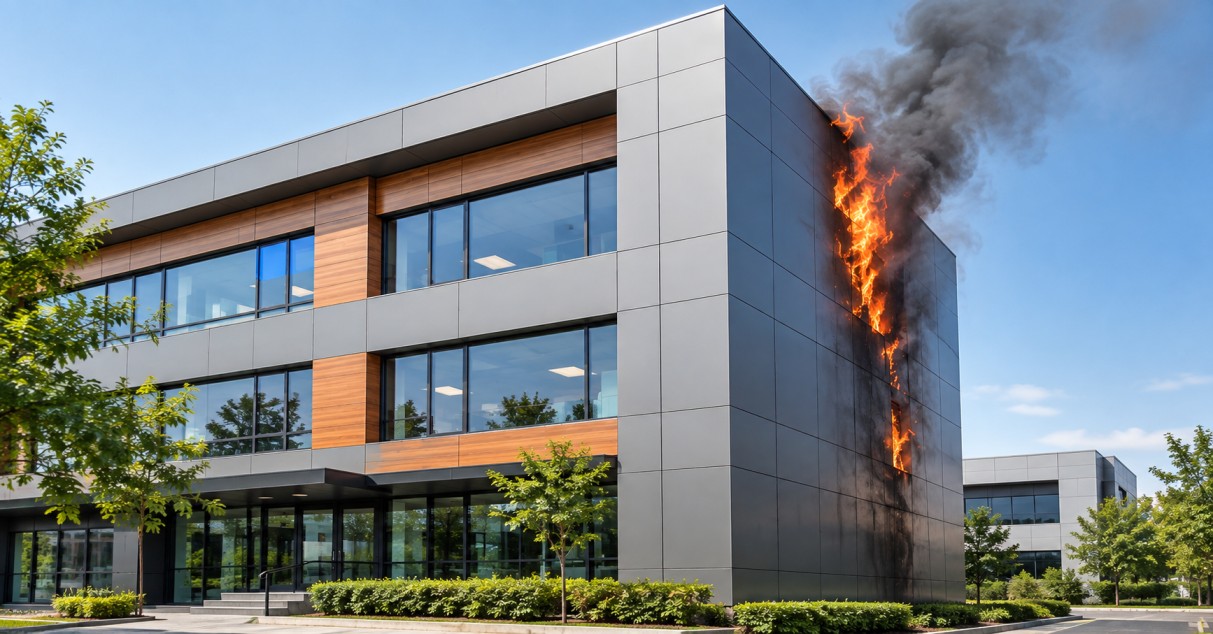
A facade can be beautiful and technically advanced. But when fire reaches the exterior, the cladding system becomes part of the fire story. The real question is how the complete assembly behaves.
The 2017 Grenfell Tower tragedy brought global attention to façade materials, insulation, cavities and detailing. India’s NBC 2016 similarly treats fire safety as a combination of prevention, life safety and fire protection. So, understanding external cladding fire means looking beyond the visible panel to its core, cavity, insulation, fire stops and installation.
Does Cladding Really Cause Fires?
Cladding does not normally start a fire. An ignition source comes first. However, some façade materials and assemblies can influence how rapidly flames travel once the exterior is exposed.
The whitepaper identifies five important mechanisms of facade fire spread: surface flame propagation, vertical chimney effect in cavities, flaming droplets, smoke propagation and compartmentation breach. These mechanisms explain why combustible cladding can become a serious concern on tall buildings.
The external cladding fire distinction matters. A “fire-retardant” label is not enough; the complete façade must be appropriately designed, tested and installed.
Understanding External Cladding Fire During a Fire
During a fire, the façade may face flames emerging from windows, radiant heat or fire travelling through an external cavity. Its behaviour depends on the panel, core, insulation, substructure, cavity and detailing.
Standard PE cores are combustible and can melt, contribute heat and produce flaming droplets. Mineral-filled FR cores behave differently because their inorganic content helps limit ignition and flame progression. The whitepaper’s comparison records lower flame height, heat release and molten droplets for its FR-core example.
For a high-rise, the cavity deserves particular attention. An uncontrolled vertical air path can intensify upward movement of heat and flames. Cavity barriers and fire stops are part of the fire strategy.
Five Ways Cladding Can Contribute to Fire Spread
1. Combustible Core and ACP Fire Spread
A combustible core can add fuel once sufficiently heated. The whitepaper notes that PE cores can melt easily and contribute to accelerated ACP fire spread, while mineral or inorganic cores are formulated to retard flame progression.
2. Vertical Cavities and Facade Fire Spread
A ventilated cavity can support moisture management, but an uncontrolled vertical cavity may create a chimney effect. In fire scenarios, this can accelerate upward movement of flames and hot gases.
3. Openings and Weak Details
Windows, corners, parapets, soffits and joints can become vulnerable points. Incomplete fire stopping can create routes around intended compartmentation, increasing facade fire spread.
4. Flaming Droplets
Some combustible materials can melt and shed flaming droplets. These can ignite balconies, lower façades or nearby materials, extending ACP fire spread beyond the original location.
5. Smoke and Toxic Products
Fire safety is not only about visible flame. Smoke can impair visibility and evacuation, while combustion products can create serious health hazards. A robust assessment of combustible cladding therefore considers smoke as well as flame.
Also Read: What Is Chimney Effect? Understanding the Hidden Fire Risk in Building Facades
How Materials Behave During External Cladding Fire: What Matters
The material alone does not tell the whole story. End use and complete assembly matter.
| Material/system | Typical behaviour | What should be verified |
|---|---|---|
| Mineral/inorganic-core ACP |
Designed to limit contribution to fire | Classification and assembly testing |
| PE-core ACP | Combustible core can contribute fuel and heat | Application, code and system requirements |
| Metal sheets | Limited fuel contribution from metal itself | Coating, insulation, backing and assembly |
| Stone or masonry | Generally low combustibility | Fixings, joints and supporting system |
| Insulated rainscreen | Behaviour depends strongly on insulation and cavity | Full assembly, barriers and fire stops |
So, combustible cladding is not simply a question of whether the outer skin is metal. Coatings, insulation, membranes, adhesives, sealants and cavities can all influence external cladding fire performance.
Common Design Mistakes Behind Façade Fire Spread
A certified panel can still create risk if the tested configuration is not replicated on site. The whitepaper recommends early coordination between architects, façade engineers and fire consultants, covering cavities, barriers, joints, fixings and edges.
Common oversights include:
- treating the panel as the entire fire strategy
- leaving vertical cavities without appropriate barriers
- changing a tested assembly without checking applicability
- using incompatible insulation or backing materials
- compromising fire stops during later services or retrofit
- leaving combustible debris inside cavities
NFPA 285 illustrates why system-level evidence matters. It evaluates fire propagation characteristics of exterior wall assemblies containing combustible components, rather than simply judging an isolated panel.
This is particularly relevant when assessing ACP fire spread in real assemblies, because panel performance can change when the panel is combined with insulation, cavity and support components.
Also Read: FR ACP Explained: Why “Test Nahi Toh Trust Nahi” Matters for Building Safety
How Fire-Safe Cladding Reduces Risk
Fire-safe cladding starts with material selection, but it does not end there.
For relevant projects, specifiers should look for documented reaction-to-fire classification. EN 13501-1 provides a harmonised procedure for classifying construction products by reaction to fire. A2-s1,d0 indicates limited combustibility, low smoke production and no flaming droplets within that classification framework.
The mineral-rich cores, controlled tolerance, halogen-free formulations, suitable metal skins and documented fire performance. It also explains how Factory Production Control helps maintain consistency after laboratory testing.
Our ETA documentation identifies more than 90% inorganic content for FireWall A2 and more than 72% for FireWall B. We also operate a NABL-accredited in-house fire testing laboratory aligned with ISO/IEC 17025:2017.
For us, external cladding fire performance should be measurable, documented and repeatable.
Also Read: Aludecor Becomes India’s First ACP Manufacturer with European ETA Certification
Choosing the Right Cladding System
A safe specification is rarely based on one certificate. It begins with building height, occupancy, façade geometry, cavity design and applicable regulations.
For high-rise projects, examine:
- Core composition and declared fire classification.
- Reaction-to-fire and relevant assembly test evidence.
- Insulation and backing compatibility.
- Cavity barriers and fire-stop detailing.
- Joint, opening and parapet treatment.
- Installation instructions and approved fixing methods.
- Manufacturing consistency and batch traceability.
- Maintenance procedures protecting fire barriers throughout the lifecycle.
NBC 2026 provides India’s national framework covering fire prevention, life safety and fire protection, while local authorities and applicable regulations determine project-specific compliance.
When the Facade Becomes Part of the Fire Strategy
The smartest facade should behave predictably when conditions become unpredictable.
External cladding fire risk is therefore a system question. Material selection, cavity design, fire stops, insulation, joints, testing and workmanship must work together.
The specification conversation should move beyond “Is this panel fire-rated?” A better question is: “How does this complete façade assembly behave in a fire?”
That is the difference between ticking a specification box and designing for real safety. It is also why facade fire spread must be evaluated as a system, not a surface finish.
Call us at 1800-102-0407 or visit aludecor.com to explore MCP solutions designed for performance and long-term aesthetic value.
FAQs
1. Can ACP panels spread fire?
It depends on the core, classification and complete assembly. Combustible-core ACP can contribute fuel, while mineral-filled FR systems are designed to reduce flame and heat contribution. This is central to evaluating ACP fire spread.
2. Does all cladding increase fire risk?
No. Cladding varies significantly in combustibility and fire performance. Risk depends on the material, insulation, cavity, detailing and installation. Combustible cladding is a risk category, not a description of every façade.
3. What makes a cladding system fire-safe?
A robust external cladding fire system combines appropriately classified materials with compatible insulation, correctly designed cavity barriers, tested details, compliant installation and ongoing inspection. This is particularly important where façade fire spread could threaten multiple storeys.
4. Is A2-s1,d0 enough on its own?
Not necessarily. A reaction-to-fire classification describes product behaviour under its test. Project requirements may also call for assembly-level testing. NFPA 285, for example, evaluates exterior wall assemblies containing combustible components. This system-level approach is essential when assessing external cladding fire and combustible cladding.


