


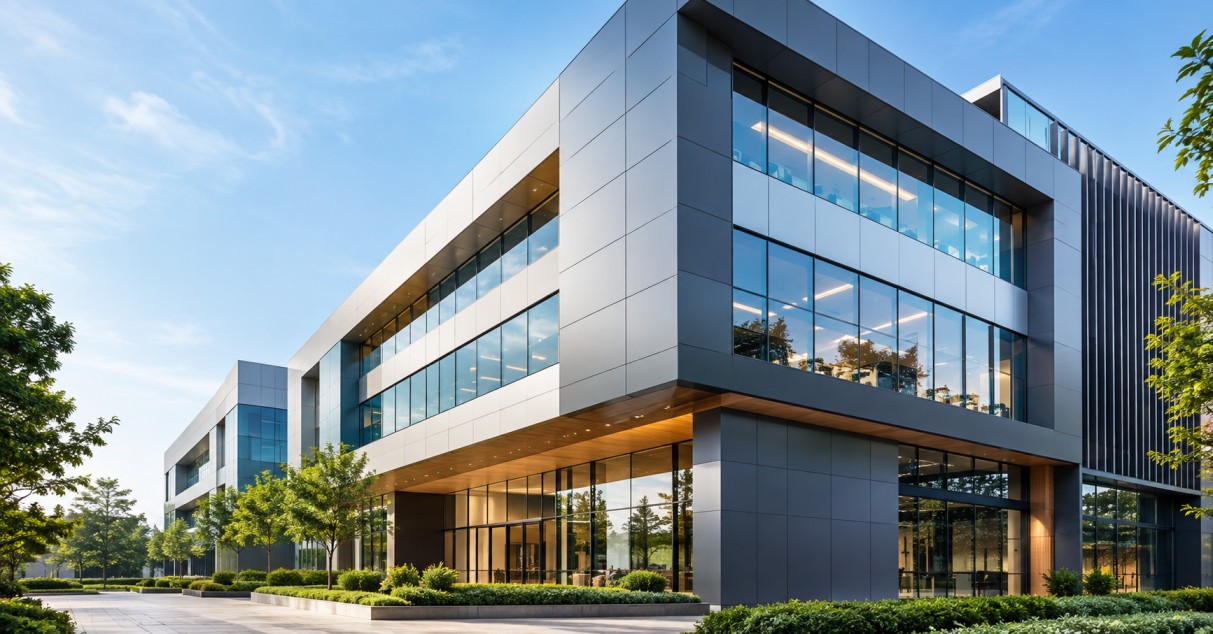
Walk past a row of office buildings and something interesting happens. You rarely remember the structural system, the specification or even the floor plate. What stays with you is the building’s visual character. The proportions, the surface, the way light moves across it and how confidently the entrance meets the street.
That is where Metal Composite Panels become interesting. They can turn a relatively straightforward building envelope into something sharper, more layered and distinctly contemporary without making the façade feel visually overworked.
At Aludecor, we have seen this design freedom evolve from simple solid shades to metallic, brushed, wood-inspired, stone-inspired and textured surfaces.
For Metal Composite Panels for Office Buildings, the real opportunity is not simply adding colour to a façade. It is about using material, geometry, texture and reflectivity to create an architectural identity that works from a distance and still rewards a closer look.
Why Office Facades Matter More Than Ever
An office building is now expected to communicate before anyone enters it.
A corporate headquarters needs to feel credible. A technology campus may want something progressive. A creative workplace might deliberately avoid the conventional glass-box appearance. And premium commercial developments often need a façade that feels distinctive without becoming theatrical.
This is why Office Building Cladding has moved beyond basic weather protection. The exterior increasingly becomes part of the brand experience.
Our experience with Metal Composite Panels reflects that shift. Aludecor offers more than 600+ shades, with collections spanning solid, Gloz, Timber, Clay, Cement, Mirror, Brushed and other decorative expressions. The current MCP portfolio also includes finishes designed for different visual effects and applications.
Also Read: The Future Wears A New Skin Exploring India’s Facade Revolution

What Makes a Modern Office Building Look Premium?
Premium does not necessarily mean expensive looking. Quite often, it comes down to restraint.
Clean panel proportions. Consistent joints. A considered colour palette. Contrast between matt and reflective surfaces. Deep reveals around windows. Carefully positioned vertical fin louvers. These details create visual hierarchy.
The advantage of Metal Composite Panels is that several of these elements can be developed using the same basic façade material. A dark metallic surface can frame a lighter wall. A wood-inspired finish can soften a rigid corporate elevation. A brushed metallic finish can highlight an entrance or canopy.
And there is another benefit. Large-format panels allow designers to maintain cleaner visual planes with fewer unnecessary interruptions.
That is particularly useful in Modern Office Facade design, where simplicity is often harder to achieve than ornamentation.
Also Read: 5 Ways to Ensure Long-Lasting ACP Sheet Facades That Don’t Fade Over Time
How Do Metal Composite Panels Improve Office Building Aesthetics?
With Metal Composite Panels, architects can work with colour, finish, pattern, panel orientation and geometry rather than being restricted to a single surface language. Aludecor’s portfolio includes solid shades, metallics, brushed finishes and nature-inspired options.
A façade can therefore have a quiet base tone with stronger accents around the entrance. Different finishes can distinguish one building volume from another. Vertical panels can emphasise height, while horizontal modules can make a large elevation appear more grounded.
This flexibility is one reason Metal Composite Panels for Office Buildings work particularly well for large commercial developments and the aesthetic benefit is not limited to the exterior. MCPs can also be used for interior wall panelling, ceilings, reception areas and other architectural features, allowing a visual language to continue from outside to inside.

Explore Colours, Textures, Metallic Finishes and Patterns
Colour can make a building recognisable. Texture can make it memorable.
Aludecor’s current shade portfolio includes hundreds of options, from conventional whites and greys to metallic, mirror, brushed, timber-inspired and other decorative finishes.
For example, a corporate project could combine a neutral grey with a brushed metallic accent. A hospitality-led office development might use warmer bronze or timber-inspired surfaces. A technology campus could take a cooler palette with reflective elements.
Our Metal Composite Panels can also support more expressive design approaches. Aludecor’s earlier commercial façade work highlights the use of colours, patterns, textures and three-dimensional forms to create distinctive elevations.
The trick is knowing when to stop. Too many finishes competing together can make even a premium façade look confused.
Also Read: Explore Aludecor’s 600+ ACP Sheet Colour Shades for Limitless Design Possibilities
How MCPs Help Create Clean and Contemporary Facades
There is something satisfying about a façade where everything seems to line up.
The panel joints follow the architectural grid. Corners look deliberate. Window openings sit comfortably within the module. Service areas disappear into the composition instead of interrupting it.
This is where Office Building Cladding can become part of the architecture rather than simply sitting over it.
Metal composite panels are lightweight and can be fabricated into different shapes and forms. Aludecor’s technical information also highlights their use across façade, wall-panel, canopy and other architectural applications.
That flexibility helps architects create disciplined elevations without sacrificing visual interest.
Can Metal Composite Panels Create a Distinctive Corporate Identity?
Absolutely, and this may be one of their most underrated advantages.
Corporate architecture increasingly needs a recognisable visual signature. The façade can become part of that identity through a particular colour, finish, pattern or combination of materials.
A company could use a deep blue accent around its principal entrance, metallic panels on prominent volumes and a restrained neutral finish across the wider façade. The result does not need to look like a giant logo. It simply needs to feel recognisably its own.
That is where Modern Office Facade design becomes more strategic. Material selection can support the brand without turning architecture into advertising.

Aludecor’s product range also includes applications categorised for Corporate Identity Design, alongside exterior, interior, façade and wall-cladding uses.
How Do MCPs Support Creative Facade Forms and Detailing?
A flat wall is only the beginning. Metal Composite Panels can be routed, folded and fabricated to create returns, fins, cassettes, reveals and other architectural details. This makes them useful when an architect wants depth rather than a completely planar façade.
A building entrance can project forward. Window surrounds can become deeper. A corner can be sharpened with folded panels. A canopy can continue the same material language from the elevation.
The lightweight nature of MCP systems can also reduce the structural support required compared with heavier façade materials, while supporting relatively quick installation. Aludecor’s technical documentation specifically highlights lightweight construction, faster installation and reduced structural support requirements as advantages of MCP systems.
This makes Metal Composite Panels for Office Buildings particularly useful where visual ambition needs to coexist with practical construction requirements.
MCPs vs Traditional Facade Materials for Office Buildings
There is no single material that suits every project. Still, MCPs have a useful combination of properties for commercial architecture.
| Consideration | Metal Composite Panels | Traditional Heavy Façade Materials |
|---|---|---|
| Weight | Relatively lightweight | Often considerably heavier |
| Finish choice | Extensive range of finishes | Depends strongly on the material |
| Fabrication | Cutting, routing and folding possible | Often more material-specific |
| Colour consistency | Factory-applied finishes can provide consistent colour | Varies by material and finish |
| Design flexibility | High | Varies by material |
| Installation | Can be comparatively quick | Often more labour-intensive |
| Maintenance | Depends on coating, material and exposure | Depends on material and finish |
For Metal Cladding for Offices, the key attraction is the balance between appearance and constructability. The material can create a premium visual result without automatically requiring a correspondingly heavy façade build-up.
What Should Architects Consider When Selecting MCP Finishes?
This is where specification needs to become more thoughtful.
First, consider where the panel will be used. Exterior façades face sunlight, rain, pollution and temperature changes, so the coating system needs to match the exposure. Aludecor’s technical material covers PVDF, FEVE and Super Durable Polyester coating technologies, each with different formulation characteristics and performance considerations.
Second, consider colour. A shade that looks excellent in a showroom may behave differently under strong daylight. Metallic and special-effect finishes can also change visually depending on viewing angle and illumination.
Third, think about scale. A colour on a small sample can feel completely different when repeated across several thousand square metres.
Finally, do not separate aesthetics from performance. Aludecor’s ACP range includes different grades and core options, with selection depending on application, height and performance requirements. For demanding exterior and high-rise applications, appropriate fire-rated and weather-resistant specifications need to be evaluated rather than choosing purely on appearance.
This is where Metal Composite Panels become more than a decorative decision. The finish, grade, coating, fabrication and installation system all need to work together.
When the Facade Starts Speaking for the Building
A good office façade does not need to shout.
Sometimes a restrained palette, a carefully placed metallic accent and a strong panel rhythm can say more than an elaborate elevation. At other times, bold colour, texture and geometry are exactly what the architecture needs.
That is the real strength of Metal Composite Panels. They give architects a broad material vocabulary while keeping the façade system relatively lightweight and highly workable.
At Aludecor, we have built our MCP portfolio around that idea, from conventional shades to brushed, mirror, metallic and nature-inspired finishes. Our current portfolio spans more than 500 shades and has been used across façade, interior, corporate identity and wall-cladding applications.
For architects exploring Office Facade Design, the opportunity is therefore much bigger than simply selecting a colour. It is about deciding how the building should be perceived, how its different volumes should relate to one another and how the façade should continue into the spaces people actually occupy.
Because an office building is not just a workplace anymore. Its façade is part of the experience.
Call us at 1800 102 0407 or visit aludecor.com to explore MCP solutions designed for performance and long-term aesthetic value.
FAQs
What are metal composite panels used for?
Metal composite panels are used for façades, wall panelling, canopies, ceilings, interiors, signage and corporate identity applications. Their lightweight construction and fabrication flexibility make them suitable for a wide range of architectural uses.
Are metal composite panels suitable for office buildings?
Yes. They are widely used for commercial and corporate buildings because they combine lightweight construction with extensive colour, finish and fabrication options. Product grade, core, coating and fixing system should be selected according to the specific application.
How do MCPs improve façade aesthetics?
They provide designers with a broad palette of colours, metallics, textures, patterns and finishes while allowing panels to be fabricated into different forms. This enables more controlled proportions, accents, reveals and architectural detailing.
What finishes are available for office façades?
Aludecor’s portfolio includes solid, Gloz, Mirror and Brushed series, along with timber-inspired, stone-inspired, metallic and other decorative finishes. The current range contains more than 600 shades and options.
Can MCP finishes be used to reinforce corporate identity?
Yes. Colour, finish, pattern and panel composition can be used to establish a consistent visual language across façades, entrances, interiors and other branded architectural spaces. Aludecor’s product applications specifically include Corporate Identity Design.


