


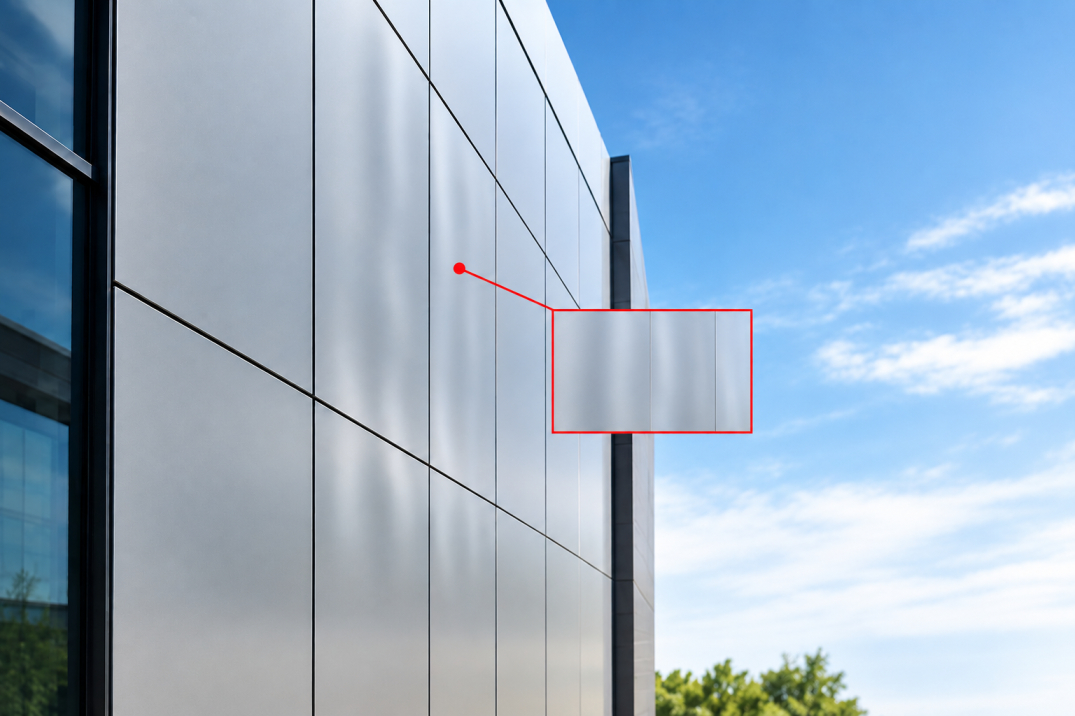
When an ACP façade shows subtle lines, ripples, shadows or uneven reflections, the immediate assumption is often that the panel is faulty. Sometimes it is, but not always.
Telegraphing in ACP Panels is one of those façade issues where the visible symptom may be blamed on the material, while the actual cause lies elsewhere. The substrate, subframe, fabrication, fixing method, thermal movement and even panel handling can influence the final appearance and that is what makes telegraphing tricky.
An ACP panel becomes part of a larger façade system once installed. So, when something looks uneven, inspecting only the panel may not reveal the complete picture.
Let’s look at what is really happening.
What Is Telegraphing in ACP Panels?
Telegraphing is the visible appearance of underlying irregularities through the surface of a finished panel. In an ACP façade, it may appear as faint lines, waves, ridges, depressions or changes in reflected light.
It is particularly noticeable across large, uninterrupted surfaces or highly reflective finishes, where even minor variations can catch the eye.
But telegraphing should not automatically be confused with delamination, bubbling or coating failure. These are different issues with different causes.
A panel can meet its required specifications and still show visual irregularities after installation if the supporting system introduces stress or unevenness.
That is why Telegraphing in ACP Panels needs to be assessed as part of the complete façade system.
Why Telegraphing in ACP Panels Happens: Understanding the Root Causes
There isn’t always one culprit. Several factors can work together.
- Uneven substrate or supporting framework
The first thing to check is the framework behind the panel. If the supporting structure is not properly aligned, its irregularities can become visible through the finished ACP surface. This is especially noticeable across large panels and long sightlines. A façade may look fine up close but reveal variations when viewed from a distance or under strong sunlight.
- Incorrect fixing or excessive restraint
Aluminium expands when heated and contracts when cooled. The façade system needs to accommodate this movement. If panels are fixed too tightly or movement is unnecessarily restricted, stresses can develop within the assembly and contribute to distortion. Thermal movement should therefore be considered during design, not after installation.
- Fabrication-induced stress
Routing, grooving, cutting and folding are routine ACP processes. But accuracy matters.
Incorrect routing depth, inaccurate dimensions or improper folding can introduce stress into the finished panel or cassette. A panel that arrives flat at site may therefore behave differently after fabrication.
- Manufacturing flatness and material consistency
Material quality still matters, ACP manufacturing involves bonding aluminium skins to a core under controlled conditions. Variables such as roller settings, temperature, pressure, cooling and residual stress can influence flatness.
So yes, the panel can sometimes be responsible. The important part is to establish the cause rather than assume it.
Also Read: What Is the Chimney Effect in Facades? A Fire Risk Guide
When the ACP Panel Isn’t the Problem
This is where Telegraphing in ACP Panels is often misunderstood. Imagine a panel being installed over a framework with local variations and then fixed tightly against it. Those variations may become visible on the finished surface. From outside, it looks like a panel problem, remove the panel and you may notice it to be perfectly flat.
A proper investigation should therefore check:
- Panel flatness before fabrication
- Panel thickness and dimensions
- Skin and core consistency
- Routing and folding accuracy
- Subframe alignment
- Fixing arrangement
- Joint detailing
- Thermal movement provisions
- Storage and handling
- Appearance under different lighting conditions
Lighting deserves attention too, reflective finishes can make minor surface variations appear more pronounced under certain conditions. So, what looks significant in direct sunlight may appear far less noticeable under diffuse light.
How Material Quality and Installation Work Together
Good ACP and good installation go hand in hand, high-quality manufacturing provides consistent panel geometry, bonding and surface characteristics. But even a well-manufactured panel cannot compensate for an incorrectly aligned framework or poor fabrication.
Likewise, a perfectly aligned subframe cannot correct an inconsistent panel. This is why Telegraphing in ACP Panels should be considered a system-level issue.
Take a simple example. A 4 mm ACP panel may be flat before fabrication. If it is inaccurately routed or folded, the finished cassette can develop unwanted stress. If the supporting framework is also misaligned, fixing may add further tension, add temperature changes and the resulting visual variation may become more noticeable. Often, it isn’t one major mistake. It is several small deviations adding up.
Also Read: Top 5 ACP Installation Mistakes to Avoid for Long-Lasting Cladding
Best Practices to Minimize the Risk of Telegraphing
The risk can be reduced considerably through proper planning and execution.
- Check the substrate first
Ensure the supporting framework is properly aligned before installation. Establish reference lines and verify dimensions rather than relying on visual inspection alone.
- Inspect panels before fabrication
Check panels for distortion, damage or handling issues as soon as they arrive. This establishes a useful baseline before fabrication begins.
- Follow the manufacturer’s fabrication guidelines
Routing depth, cutting, folding and tooling all matter. Product-specific fabrication recommendations should be followed rather than relying only on generic workshop practices.
- Allow for thermal movement
Aluminium is not dimensionally static. The façade system must provide appropriate allowance for thermal movement based on panel dimensions, fixing arrangements, environmental conditions and manufacturer recommendations.
- Store and handle panels correctly
Protect panels from moisture, condensation and unsuitable storage conditions. Proper stacking and handling can help prevent damage before installation even begins.
- Evaluate the finished façade realistically
Don’t judge the surface only from a few centimetres away under intense inspection lighting.
View it from the intended distance and under different daylight conditions. Long sightlines and reflective areas deserve particular attention.
Also Read: What Separates Aludecor as a Reliable ACP Brand from the Rest?
What Architects, Fabricators and Installers Should Keep in Mind
For architects, the key takeaway is simple: specify the façade system, not just the panel. Panel thickness, finish, fabrication, subframe, fixing arrangement, joints and thermal movement provisions all influence the final result.
For fabricators, precision matters. Small errors in cutting, routing or folding can become highly visible once repeated across a large façade.
For installers, the supporting framework deserves as much attention as the visible panel. A façade can only be as geometrically consistent as the system supporting it.
At Aludecor, we approach ACP as a complete material system. Our product development and testing philosophy focuses on measurable performance. The same principle applies when investigating an unexpected façade characteristic: test and inspect before reaching a conclusion.
Look Beyond the Panel
Telegraphing in ACP Panels can be linked to material quality, but it can also result from fabrication, fixing, framework alignment, thermal movement or a combination of these factors.
So, calling it a panel problem without investigating the complete installation can be an oversimplification. The better approach is diagnostic. Check the panel, fabrication, subframe, fixing and movement provisions. Then assess the finished façade under realistic viewing conditions.
Because a good façade isn’t created by a good panel alone. It comes from the right material, accurate fabrication and disciplined installation working together.
Call us at 1800 102 0407 or visit aludecor.com/enquiry to explore ACP solutions designed for performance and long-term aesthetic value.
FAQs
What is Telegraphing in ACP Panels?
Telegraphing is when underlying irregularities such as lines, waves or depressions become visible on an ACP surface. It can result from the panel, fabrication, subframe or fixing system.
Does Telegraphing in ACP Panels indicate poor ACP quality?
Not necessarily, material quality can contribute, but uneven subframes, inaccurate fabrication, excessive restraint and thermal movement can also play a role.
Can Telegraphing in ACP Panels be prevented?
The risk can be significantly reduced through quality-controlled ACP, accurate fabrication, proper subframe alignment, correct fixing and adequate provision for thermal movement.


