


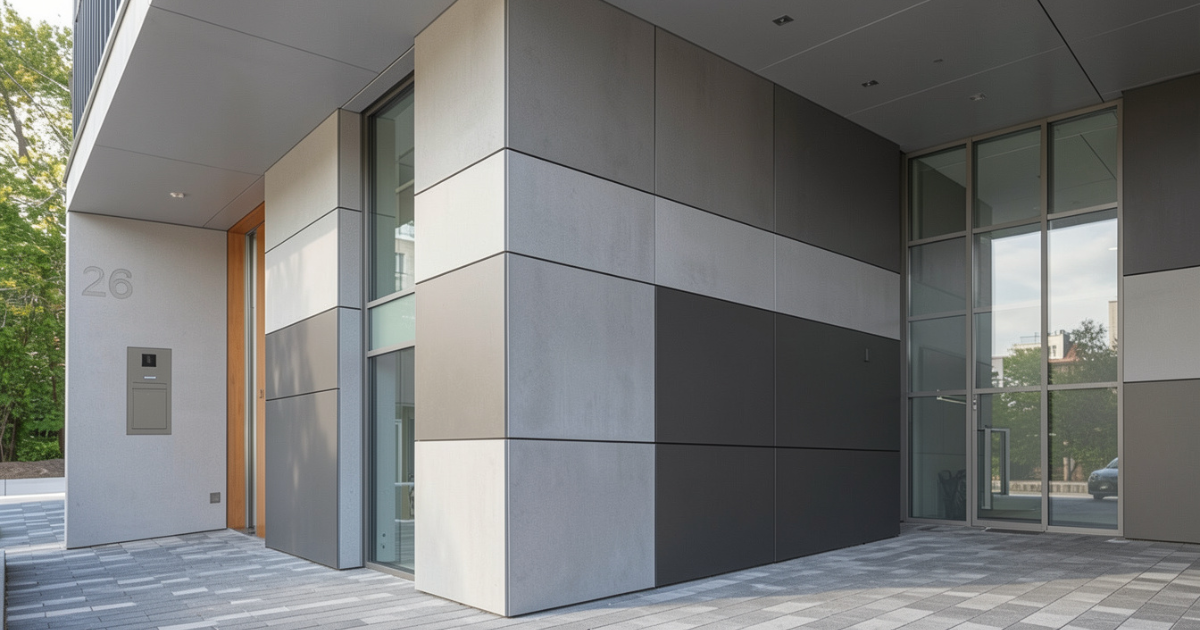
Picture this. You’re walking past a building and something stops you. Not the glass, not the signage. It’s the façade. Rough, raw, elemental. That slightly porous, brooding quality of concrete that somehow manages to feel both ancient and razor-sharp at the same time. You see it on boutique hotels, contemporary office towers, upscale residences and suddenly, it’s everywhere. And once you notice it, you genuinely can’t unsee it.
But here’s what nobody really says out loud: achieving that aesthetic with actual concrete is, in practice, a structural, logistical, and environmental nightmare. The dead weight alone complicates entire building frames. The carbon footprint is substantial. The installation timeline? Lengthy. The maintenance story? Not a pleasant one.
That’s precisely the conversation we at Aludecor were having with architects across the industry and the answer to that long-pending demand was Mason Mark, our masonry-inspired concrete wall panel series. A tribute to the art of masonry. The full gravitas of raw cement, without any of the weight, waste, or guilt.
The Growing Popularity of Concrete-Inspired Design in Architecture and Designing
Ask any architect working on a commercial project today and they’ll tell you the industrial aesthetic isn’t a trend anymore. It’s a design language. What started as a niche expression rooted in brutalist architecture has steadily filtered into mainstream commercial and residential vocabularies over the past decade and a half. Architects are specifying it. Interior designers are demanding it. Property developers are selling entire projects on the strength of it. Raw concrete surfaces signal a kind of unvarnished authenticity, a design confidence that says the building has nothing to prove and nothing to hide.
And it’s not just a stylistic whim. There’s a far older, deeper story running underneath it all. Masonry has been the backbone of civilisation since 7000 BC. From the mudbrick walls of Jericho and the limestone pyramids of Egypt to the Roman invention of concrete (opus caementicium, volcanic ash, lime, and rubble that literally built an empire), through the soaring stonework of Gothic cathedrals and the Renaissance synthesis of art and engineering, each era left its mark in stone, in brick, in mortar. And each generation of builders was, in their own way, paying tribute to the masons who came before them. That’s the historical weight, quite literally behind the concrete aesthetic, and it’s why it resonates so deeply in contemporary design.
There’s a reason we call Mason Mark “a tribute to the art of masonry” because every raw concrete surface that makes you pause carries a story shaped over millennia, crafted by skilled, often unsung hands that built our homes, our cities, and the very foundations of civilisation. That legacy is what this aesthetic embodies. And that is what we set out to honour.
But here’s the uncomfortable truth sitting beneath all that visual appeal. Real cement is a significant polluter. For every tonne produced, there’s a measurable environmental cost: more carbon in the atmosphere, more energy consumed, more landscapes scarred, more pollution in communities near manufacturing plants. And beyond the environmental toll, cast-in-place concrete cladding adds enormous dead load to structures, complicates installation timelines, and inflates project costs considerably. So the design world found itself in a bind – craving the aesthetic, dreading the consequences.
That’s exactly the gap that Aludecor’s Mason Mark series was designed to fill.
Also Read: Why Third-Party Testing Is Becoming a Key Requirement in Large Projects
What Is Mason Mark ACP from Aludecor?
Mason Mark is our masonry-inspired Metal Composite Panel (MCP) series, a tribute, in the truest sense of the word, to the skilled artisans whose craft has shaped to build the environment across millennia. We describe it simply as “a tribute to the art of masonry,” and we mean every syllable of that. The series draws inspiration from the raw, elemental beauty of traditional masonry and translates it into a contemporary concrete wall panel format that is lightweight, durable, and precision-engineered.
We’ve been in the Metal Composite Panel industry for over two decades, and during that time we’ve consistently pushed the boundaries of what a surface material can be. Mason Mark represents the culmination of that accumulated knowledge, a series that doesn’t just mimic concrete but, as we put it ourselves, refines and transforms it, turning raw cement aesthetics into a sophisticated visual experience.
Achieving the Raw Concrete Look with ACP Technology
The visual authenticity of Mason Mark rests on a proprietary Three-Coat Raw Tech Paint System. This isn’t standard coil-coating technology. The coating thickness on the front coil runs between 30µ and 50µ, applied in three deliberate coats using paints supplied by globally recognised names including AkzoNobel, PPG, Beckers, and Nippon. The result is a surface with genuine tactile depth: subtle tonal shifts, micro-variations in pigment distribution, and that slightly porous, granular visual character that makes real concrete so captivating.
The six shades in the Mason Mark range are each named after historic masonry landmarks from around the world. Roman Wall (MM 11), Florence Wall (MM 12), Bruges Wall (MM 13), Giza Wall (MM 14), Athena Wall (MM 15), and Yorkshire Wall (MM 16). Each shade comes in two surface formats: the flat masonry panel and the Strata variant (prefix LVR), which features a precision-ribbed, vertically louvred profile that adds architectural dimensionality to any façade. Think of it as the difference between a smooth plaster render and a board-formed concrete finish, both unmistakably concrete, but with completely different personalities.

Lightweight Alternative to Traditional Concrete Cladding
This is where the engineering story gets genuinely interesting. Our acp wall panel products are significantly lighter than any concrete cladding system you’d consider for the same application. While traditional options place considerable load on a building’s structure, Mason Mark acp wall panels impose only a fraction of that demand.
That’s not just a minor detail, it’s a structural advantage. Reduced load translates into more efficient framing, optimised foundation design, and meaningful savings in overall material consumption across the project.
From a sustainability perspective, the benefits are equally compelling. Mason Mark delivers substantially lower CO₂ emissions compared to conventional cement-based materials, is highly recyclable, and is engineered for extended durability beyond traditional alternatives. These aren’t just marketing claims, they’re measurable performance advantages that matter when specifying materials for GRIHA or IGBC-rated projects.
Key Features of Mason Mark ACP Panels
The technical specifications of Mason Mark are worth understanding in some detail, because they’re what separate a decorative surface product from a genuine architectural cladding system.
The series is available across four product grades: AL 63 (6mm total thickness with AA1100 aluminium alloy), AL 45 (4mm with AA3105/AA5005 alloy, 0.50mm aluminium skin, the premium-grade option), AL 43 (4mm), and AL 33 (3mm), all sourced from Hindalco aluminium. The aluminium skin on the back coil carries a 4µ–7µ service coat, while the front coil gets that distinctive Three-Coat Raw Tech Paint System we mentioned. Product tolerances are tightly controlled: width tolerance of ±2.0mm, length tolerance of ±4.0mm, panel squareness deviation capped at a maximum of 5.0mm.
The series carries a minimum 10-year warranty. And as part of the wider Aludecor portfolio, the world’s most tested MCP brand with over 205 documented product tests one can be confident that these numbers aren’t aspiration, they’re verification.
Beyond the structural specs, what really sets this concrete wall panel apart is its superior thermal performance. The composite panel construction, with its LDPE or mineral core, delivers meaningful thermal insulation that solid concrete cladding simply cannot match without additional build-up. For energy-efficient building design increasingly non-negotiable in both commercial and residential sectors that thermal advantage translates to reduced operational energy demand over the building’s lifetime.
Ease of Installation Compared to Solid Concrete
The installation story of traditional concrete cladding is, frankly, one of its least-discussed drawbacks. Precast or cast-in-place systems demand specialist structural engineering input, heavy lifting equipment, extended curing timelines, and a workforce with very specific skills. It’s slow. It’s expensive. And on complex façade geometries, it becomes nearly impossible.
Mason Mark acp wall panel panels mount to standard aluminium sub-frame systems using conventional cassette or panel fixing methods. They can be cut, routed, bent, and fabricated on-site or in a workshop using standard metal composite panel tools. There are no curing times, no specialist concrete trades required, no structural overload concerns. A façade that might take eight to ten weeks in precast concrete can be clad in Mason Mark in a fraction of that time. And because each panel is consistently dimensioned to tight tolerances, there’s far less waste on site which matters both for cost and collective environmental conscience.
Applications in Commercial, Residential, and Industrial Projects
The versatility of Mason Mark as a concrete wall panel system means it moves comfortably across multiple project typologies. And honestly, that’s one of the things we’re most proud of about this series.
In commercial applications, the concrete aesthetic has become the signature look of the modern workplace. Tech campuses, co-working spaces, boutique office developments, they all benefit from that urban, industrial gravitas that Mason Mark delivers. The Bruges Wall (MM 13) and Yorkshire Wall (MM 16) shades, both in the deeper charcoal-to-near-black range, work particularly well on commercial exterior façades where you want the building to project authority without being visually aggressive. Pair the Strata louvred variant with a glass curtain wall and you have something genuinely striking.
For retail and hospitality, the lighter Giza Wall (MM 14), a warm off-white concrete tone and the mid-grey Roman Wall (MM 11) create the kind of textural backdrop that makes interior merchandise, signage, and branding pop. Malls, airport retail zones, hotel lobbies, these are exactly the kinds of high-footfall, high-visibility environments where the surface needs to look premium at close quarters but also read well from across a large concourse. Mason Mark does both.
Also Read : The Science Behind Long-Term Colour Stability in ACP Sheets

Residential projects, from premium apartment blocks to standalone luxury residences, are increasingly specified with concrete-look cladding on exterior façades, feature walls, and entrance lobbies. But the structural engineers on residential projects are often the most conservative about dead load. That’s where our acp wall panel system becomes an easy conversation, you’re getting the aesthetic the architect wants without loading up the structure in ways that require expensive remediation.
Industrial and logistics facilities might not be the first application you’d associate with a premium surface finish, but there’s a growing movement towards what you might call “industrial chic”, factories, warehouses, and distribution centres that are designed to double as brand statements. Florence Wall (MM 12) and Athena Wall (MM 15) in their mid-to-dark grey palette work beautifully in these contexts.
And across all of these typologies, the application scope extends to both exterior cladding and interior feature walls, a flexibility that very few concrete wall panel systems can genuinely claim.
Where Heritage Meets the Future: Why Mason Mark Is More Than Just a Surface
We could have simply made a panel that looks like concrete. Honestly, that would have been enough to meet the market demand. But that’s not really what Mason Mark is about.
The series is, at its core, a philosophy embedded in a product. It’s a material expression of the idea that great architecture should honour the craftsmanship traditions that built the world while making conscious choices about the planet those buildings inhabit. Our Three-Coat Raw Tech Paint System creates textural depth that pays genuine tribute to the hand-laid masonry of the masons who shaped our cities. The lightweight composite construction ensures that paying that tribute doesn’t mean compromising on structural integrity, installation efficiency, or environmental responsibility.
Masonry has been with us since 7000 BC, from the earliest mudbrick structures through to the stone wonders of ancient Egypt, the arched ingenuity of Rome, the vertical ambition of Gothic Europe, and the Renaissance synthesis of beauty and engineering. Mason Mark is the next chapter in that timeline. The present day. Where heritage craftsmanship and forward-thinking material science converge in a panel that is visually striking, technically advanced, environmentally considered, and built for impact, without leaving one on the planet.
And if you’re working on your next project and wondering whether this might be the right material call? We think you already know the answer.
FAQ
- What is Mason Mark ACP and how does it replicate concrete?
Mason Mark is Aludecor’s masonry-inspired Metal Composite Panel series, engineered to deliver the visual and textural character of raw concrete cladding through our proprietary Three-Coat Raw Tech Paint System applied at 30µ to 50µ on the front aluminium coil. The result is a surface with genuine layered depth: tonal shifts, micro-granularity, and that slightly weathered elemental quality that makes real concrete so compelling. It’s not a flat grey, it moves with light, exactly as concrete does. The series offers six shades: Roman Wall, Florence Wall, Bruges Wall, Giza Wall, Athena Wall, and Yorkshire Wall, each available in a flat panel and a Strata ribbed variant. Paint supply comes from globally accredited manufacturers including AkzoNobel, PPG, Beckers, and Nippon.
- Is concrete-finish ACP suitable for exterior façades?
Yes, absolutely. Mason Mark acp wall panel products feature an aluminium alloy skin bonded to an LDPE or mineral core, making them inherently weather-resistant, thermally stable, and far less susceptible to efflorescence or biological growth than real concrete. Backed by a 10-year warranty and a service life that outlasts traditional materials by up to 20 years, this concrete wall panel system is purpose-built for exterior applications across commercial, residential, and hospitality projects.
- How does Mason Mark ACP compare to real concrete in weight?
This is where the difference becomes significant. Being an acp wall panel, Mason Mark is considerably lighter than traditional concrete cladding. This reduces structural load, simplifies installation and allows for greater design flexibility, especially in high-rise or retrofit projects.
- Does concrete-look ACP require special maintenance?
No, and this is one of the genuinely underappreciated advantages of choosing Mason Mark acp wall panel over real concrete cladding. That’s one of its biggest advantages. Unlike real concrete which may require sealing and periodic treatment, Mason Mark panels are low maintenance. Regular cleaning with mild solutions is sufficient to retain their appearance and performance over time.


