


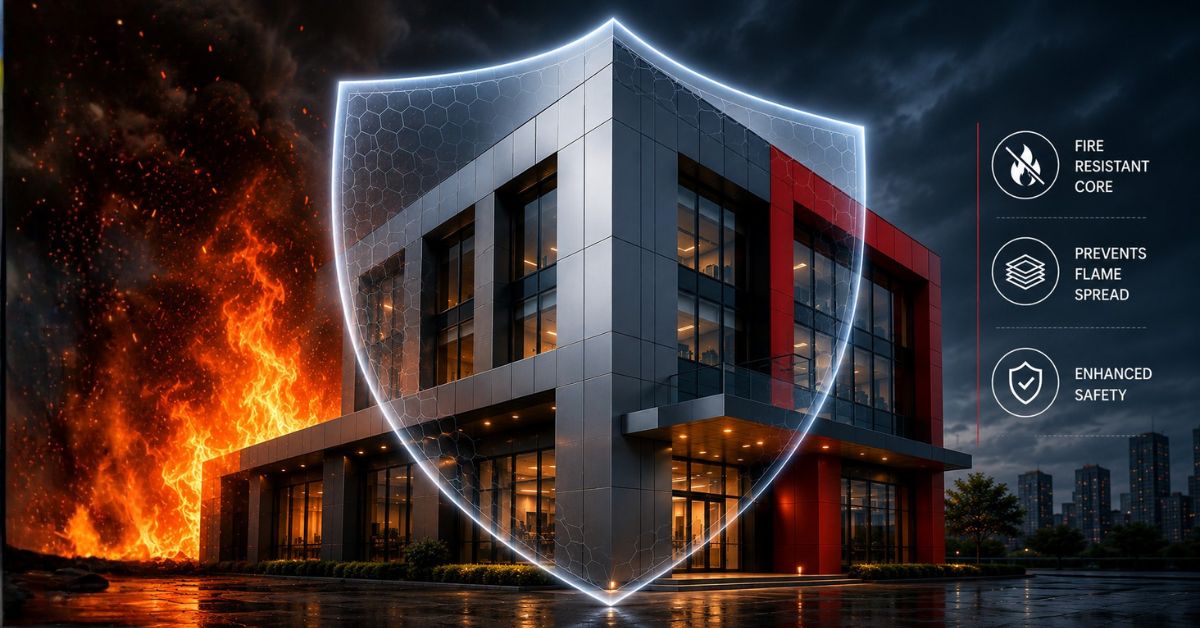
Fire safety isn’t the most glamorous part of façade design. Nobody stands in front of a building and says, “Wow, look at its fire performance.” But when things go wrong, that’s the only thing that matters.
Modern façades are layered, ventilated and often lightweight. And while that’s great for design flexibility, it also means materials must be chosen with far more caution. This is exactly where a fire retardant ACP sheet comes into the conversation. Not as an upgrade but as a necessity.
We’ve seen how expectations have changed. Clients don’t just want aesthetics anymore. They want assurance. They want proof that the material won’t contribute to a disaster. And honestly, that’s a fair ask.
So, let’s talk about how FR grade panels actually behave in a fire scenario. And why they’re not just “better” but fundamentally different.
Why Fire Safety Is Critical in Modern Construction
Buildings today are vertical ecosystems. High-rise towers, dense commercial hubs, mixed-use complexes. Fire doesn’t just spread horizontally anymore, it climbs fast.
Now here’s something many people overlook. The façade can either slow down fire or accelerate it. There’s no middle ground.
Traditional ACP panel systems with LDPE cores are combustible. Once ignited, they can contribute to flame spread, molten droplets and dense smoke. And that’s exactly what modern fire codes are trying to eliminate.
According to available data, fire incidents in India account for over 25,000 deaths annually. A significant number of these cases involve combustible materials in building envelopes.
So, regulations have become stricter. Standards like EN 13501-1, BS 476 Part 6 & 7, and NFPA 285 are now widely referenced. These don’t just test whether something burns. They evaluate how flame spread, smoke density, heat release, and droplet formation react during fire.
And that’s where a fire retardant ACP sheet starts making a measurable difference.
Also Read: How Aludecor’s Fire-Tested ACP Sheets Comply with Global Safety Standards
What Are FR Grade ACP Panels?
Now this is where clarity matters. Because terms like fireproof, fire resistant and fire retardant are often used interchangeably. But they’re not the same.
Fireproof doesn’t really exist. No material is completely immune to fire. Fire resistant materials can withstand fire for a defined duration.
And fire retardant materials? They are designed to slow down combustion, delay ignition, and reduce intensity.
An ACP panel in FR grade uses a mineral-filled core instead of a pure polyethylene one. Typically, this includes aluminium trihydroxide or magnesium hydroxide. When exposed to heat, these compounds undergo endothermic reactions. They release water molecules, absorb heat and suppress flame growth. So instead of fuelling the fire, the panel actively resists it.
At our end, Aludecor FR ACP panels are engineered with controlled inorganic content. For instance, A2 grade panels contain over 90% inorganic material, which significantly limits combustibility and smoke emission.
That’s not a minor tweak. That’s a complete shift in how the panel behaves under fire exposure.
How FR ACP Sheets Slow Down Fire Spread
Alright, let’s get into the mechanics. Because this is where things get interesting. A fire retardant ACP sheet doesn’t “stop” fire. But it interferes with it at multiple levels.
- Ignition delay – The mineral core requires higher temperatures to decompose. So, the panel doesn’t catch fire immediately. That delay matters.
- Heat absorption – The chemical reaction inside the core is endothermic. It absorbs heat energy from the fire which means less energy is available to sustain combustion.
- Controlled flame spread – Tests like EN 13823 (Single Burning Item) measure parameters like FIGRA (Fire Growth Rate) and THR (Total Heat Release). For Class B panels, FIGRA is limited to ≤120 W/s and THR to ≤7.5 MJ. These aren’t just numbers. They indicate how aggressively fire can grow across the surface.
- Negligible droplets – Molten dripping is one of the biggest risks in façade fires. FR panels are designed to produce zero or negligible flaming droplets.
- Smoke control – Lower smoke production improves visibility and reduces inhalation risks during evacuation.
So, when you combine all of this, a fire retardant ACP effectively slows down the fire’s ability to spread. It buys time, and in fire scenarios, time is everything.
Also Read: Fire-Retardant Materials Shaping Safer Public Spaces
Performance of FR ACP in High-Rise and Commercial Buildings
High-rise buildings are particularly sensitive to façade fires. Once flames break out of a window, they can leap upward floor by floor. This is often referred to as the chimney effect.
Now imagine that happening on a façade clad with combustible material. This is why specifying a fire retardant ACP sheet is critical in such structures. Especially in buildings above 15 metres where fire codes become more stringent.
In commercial environments like airports, hospitals or shopping centres, the stakes are even higher due to high occupancy, complex evacuation routes, and continuous operations. A standard ACP panel simply cannot offer the same level of assurance here.
We’ve designed Aludecor ACP FR panels to meet classifications like A2-s1, d0 and B-s1, d0 under EN 13501-1. These classifications ensure low smoke production, limited flame spread and zero flaming droplets.
And when integrated into a properly engineered façade system with fire barriers and correct installation, the performance improves significantly.
Honestly, besides the material, the system and the detailing also matter. Still, at the core of it, a fire retardant ACP sheet provides that first line of defence.
Also Read: Why Every Commercial Project Should Use Fire Retardant ACP
Additional Safety Benefits for Occupants and Structures
Fire safety isn’t just about stopping flames rather it’s about reducing harm.
One of the biggest advantages of a fire retardant ACP sheet is low smoke emission. High smoke density can disorient occupants, slow evacuation and increase toxicity levels. FR panels are designed to minimise this risk.
Then there’s structural protection. Lower heat release means reduced thermal stress on load-bearing elements. Which helps maintain structural integrity for longer durations.
Another aspect is evacuation safety. Because FR panels delay flame spread, they create a safer window for occupants to exit. That’s not theoretical, that’s a practical life-saving performance.
With Aludecor ACP, we’ve also focused on consistency. Our in-house pelletizing process ensures uniform mineral core composition across batches. Which means predictable fire performance and honestly, predictability in fire behaviour is something the industry desperately needs.
So yes, a fire retardant ACP doesn’t just protect buildings, it protects people.
Significance of Material Choice in Fire Safety
Fire safety isn’t something you retrofit. It’s something you design into the building from day one.
And when it comes to façades, the choice of material plays a defining role.
A fire retardant ACP sheet doesn’t eliminate fire. But it slows it down. It reduces its intensity. It prevents it from spreading uncontrollably.
At Aludecor, we approach this with a simple mindset. Performance must be proven, not assumed. Our Aludecor ACP FR panels are tested, certified and engineered to deliver exactly that.
Because in the end, even a few extra minutes can change everything.
Call us at 1800 102 0407 or visit aludecor.com/enquiry to explore ACP solutions designed for performance and long-term aesthetic value.
FAQs
What does FR grade mean in ACP?
FR grade refers to fire retardant properties in an ACP panel. It means the core contains mineral fillers like aluminium trihydroxide that slow down combustion.
A fire retardant ACP sheet is designed to reduce flame spread, limit smoke generation and prevent molten dripping. It does not make the panel fireproof but significantly improves its behaviour during fire exposure.
Are FR grade Aludecor ACP panels suitable for high-rise buildings?
Yes, they are specifically designed for such applications. High-rise buildings require materials that can control vertical fire spread.
Our Aludecor ACP FR panels meet international standards like EN 13501-1 and are suitable for both façade and high-risk applications.
However, they must be used as part of a complete façade system with proper fire barriers and installation practices. A fire retardant ACP sheet performs best when integrated correctly.
Do FR ACP sheets completely stop fire or slow it down?
They slow it down. And that distinction is important. A fire retardant ACP sheet delays ignition, absorbs heat and reduces flame propagation. It helps in controlling the fire and provides additional time for evacuation and firefighting. But it does not completely stop fire. No material can guarantee that.
Are FR ACP panels mandatory for commercial buildings?
In many cases, yes. Building codes increasingly mandate fire-safe materials for commercial and high-rise structures.
Standards like EN 13501-1 and guidelines from NBC 2016 emphasise the use of fire-retardant cladding materials.


