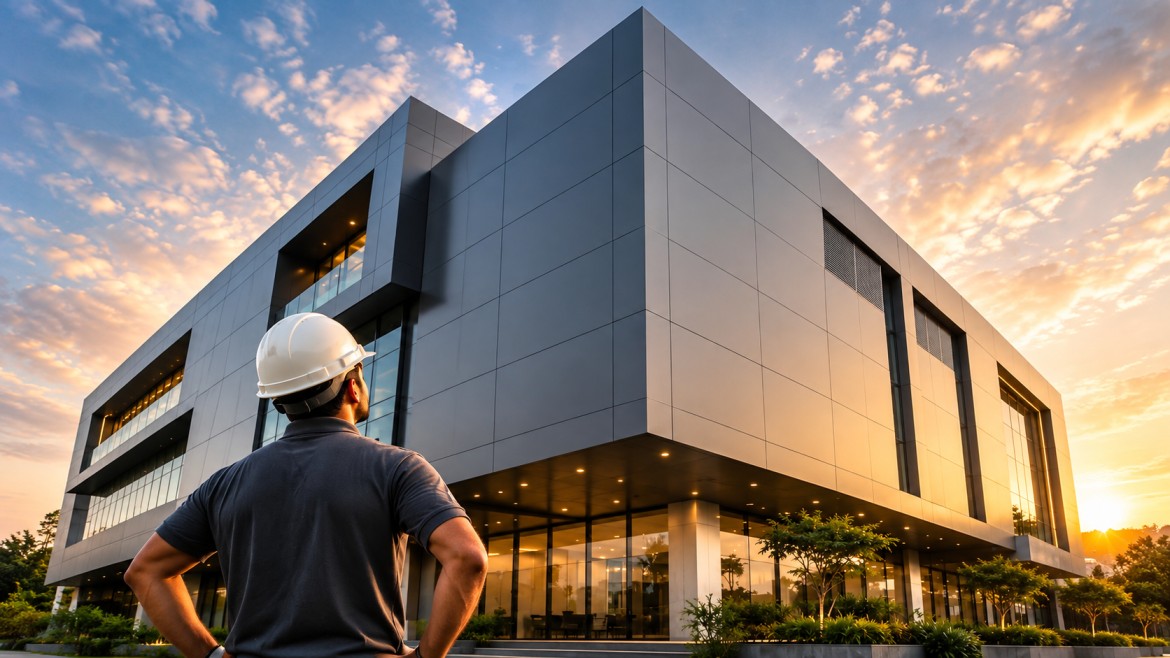
Imagine standing in front of a stunning building. The façade looks seamless, elegant and effortless. What you don’t see is the journey that brought every single panel there.
Long before an ACP sheet reaches a construction site, it has already passed through an intricate sequence of engineering, precision manufacturing, quality testing, fabrication and careful handling. Every stage shapes how that façade will perform for years to come.
Understanding the ACP sheet manufacturing process isn’t just for manufacturers. It helps architects, consultants and fabricators appreciate what separates an ordinary panel from one that delivers lasting performance. At Aludecor, we believe great façades are engineered long before they are installed.
Where It All Begins: The Raw Materials Behind ACP Sheets
Every reliable façade begins with carefully selected raw materials. The performance of an ACP sheet is determined long before it reaches the production line, starting with the choice of aluminium alloys, protective coatings, engineered cores and high-performance adhesives.
At Aludecor, we manufacture Metal Composite Panels using pre-coated aluminium coils bonded to a specially engineered core. Our portfolio also includes Zinc Composite Panels and Copper Composite Panels, offering architects greater design flexibility while maintaining the same engineering precision.
For exterior applications, aluminium alloys such as AA3105 and AA5005 are preferred for their excellent corrosion resistance, strength, flexibility and formability, ensuring reliable performance during fabrication and throughout the building’s lifecycle. Surface protection is equally important. Premium PVDF, FEVE and Super Durable Polyester (SDP) coatings provide outstanding resistance to UV radiation, weathering, chemicals and colour fading, preserving the façade’s appearance for years.

The panel is completed with either an LDPE core or a mineral-filled fire-retardant core, depending on project requirements. Together, these carefully engineered components form the foundation of the ACP sheet manufacturing process, ensuring consistent quality, durability and long-term performance.
Inside the Manufacturing Process
Once the raw materials are approved, the real transformation begins.
The ACP sheet manufacturing process is a continuous, precision-controlled operation where individual components are permanently bonded into a single engineered panel. Every stage is monitored because even minor variations can influence flatness, bonding strength or long-term durability.
The process generally follows these stages:
- Surface preparation of aluminium coils
- Coil coating and curing
- Core preparation
- Adhesive application
- Continuous lamination under controlled temperature and pressure
- Cooling and dimensional stabilisation
- Cutting into finished panel sizes
- Protective film application
Also Read: Why Aludecor’s 205 Tests Matter for Every Construction Project

One of the most critical stages is lamination. Here, the aluminium skins and core are permanently bonded using specialised adhesive technology under controlled pressure and temperature. Proper lamination ensures balanced internal stresses, helping the panel remain flat without oil canning or surface distortion after installation.
At Aludecor, our manufacturing philosophy extends beyond production speed. Every process is engineered to maintain dimensional accuracy, finish consistency and reliable bonding so that architects receive panels capable of delivering dependable long-term performance.
This disciplined approach defines the ACP sheet manufacturing process and explains why manufacturing precision cannot be separated from façade quality.
Testing ACP Sheets Before They Leave the Factory
Manufacturing is only one part of the story. Verification is equally important.
Every ACP sheet must prove that it can perform under real-world conditions before it reaches a construction site. Testing ensures consistency, compliance and confidence.

Mechanical properties such as tensile strength, yield strength and elongation are evaluated to verify that the aluminium skins maintain adequate strength and flexibility during fabrication and service. These properties directly influence the panel’s ability to resist deformation while accommodating fabrication processes like routing and folding.
Surface coatings are also assessed for:
- Colour consistency
- Gloss retention
- UV resistance
- Adhesion performance
- Chemical resistance
- Weathering durability
Fire-rated ACP panels undergo additional evaluation based on recognised international standards, including reaction-to-fire classifications such as EN 13501-1, along with other applicable fire-performance requirements depending on project specifications.
At Aludecor, quality verification forms an integral part of the ACP sheet manufacturing process. Every panel leaving our facility represents not only manufacturing precision but also validated performance.
Also Read: FR ACP Explained: Fire Safety, Grades & Testing
Packaging, Handling and Transportation to Project Sites
A perfectly manufactured ACP sheet can still be damaged before installation if it is transported incorrectly. That is why packaging deserves as much attention as production.
Each panel is protected using removable protective films that safeguard the finished surface against scratches during storage, fabrication and installation. Panels are stacked carefully, edge-protected and packed to minimise movement during transportation.
Proper storage at project sites is equally important. ACP sheets should remain on flat surfaces in dry environments and be protected from prolonged exposure before installation. Mishandling during unloading or storage can compromise surface quality long before fabrication even begins.
Careful logistics preserve the quality established throughout the ACP sheet manufacturing process, ensuring that the panels arriving on site are exactly as they left the factory.
How Architects and Consultants Specify ACP for Projects
An ACP sheet is rarely selected based only on colour.
Architects evaluate multiple technical parameters before specifying a façade system, including panel thickness, coil thickness, alloy grade, coating type, core composition, fire performance, structural loading and expected environmental exposure.
For exterior façades, wind load becomes one of the primary design considerations. Panel thickness, aluminium skin thickness and support systems are selected according to project height and local design requirements. Appropriate panel configurations for exterior applications is required to ensure adequate structural performance.
Finish selection is equally strategic. Projects located in coastal environments, industrial regions or areas with high UV exposure often require premium coatings such as PVDF or FEVE for long-term weather resistance.
Every specification decision ultimately influences fabrication, installation and lifecycle performance. That is why understanding the ACP sheet manufacturing process helps architects move beyond appearance and specify façades that perform as beautifully as they look.
Also Read: Why Architects Choose ACP Sheets for Modern Front Elevation
The Fabrication Stage: Cutting, Routing and Shaping Panels
Manufacturing creates the panel. Fabrication transforms it into architecture.
The ACP fabrication process begins after panels reach approved fabrication facilities, where they are converted into project-specific components based on architectural drawings.
Using CNC routers, precision saws and specialised machinery, ACP sheets are:
- Cut to exact dimensions
- Routed to create foldable edges
- V-grooved for clean bending
- Drilled for fixing locations
- Fabricated into cassettes and façade modules
One of the biggest advantages of ACP is its excellent workability. The aluminium alloys used allow precise machining while maintaining dimensional stability and surface quality. This enables architects to achieve sharp corners, seamless joints, complex geometries and contemporary façade detailing with remarkable accuracy.

Throughout the ACP fabrication process, maintaining routing depth, fold accuracy and protective surface handling is essential to achieving consistent installation quality.
Preparing ACP Sheets for Installation
Before panels are fixed onto a building, several preparatory checks take place.
Fabricated panels are matched against installation drawings, labelled according to elevation sequences and inspected for dimensional accuracy. Sub-framing systems are verified for alignment, plumbness and structural stability before installation begins.
This stage also includes confirming fixing details, expansion gaps and movement allowances that accommodate thermal expansion during the building’s service life.
Proper preparation ensures the ACP fabrication process translates smoothly into efficient site installation while preserving the visual continuity envisioned during design.
Also Read: Specification vs Installation: Where Most ACP Projects Go Wrong
Bringing the Design to Life: ACP Installation on Site
Installation is where engineering meets execution. Once the aluminium substructure is accurately aligned, fabricated ACP panels or cassettes are fixed using the specified installation system, ensuring proper expansion gaps and movement allowances.
A precise ACP fabrication process ensures panels fit seamlessly, resulting in cleaner joints, better alignment and faster installation. Equally important is careful handling, which protects the factory-applied finish from scratches and damage.
Successful installation is about more than aesthetics. Proper ventilation behind the panels, effective moisture drainage and correct fixing techniques all contribute to the façade’s long-term durability, structural stability and overall performance.
Final Inspection and Quality Assurance
The completion of installation does not mark the end of the journey. Every façade undergoes a detailed inspection before it is considered ready for handover.
Inspection teams verify panel alignment, joint uniformity, colour consistency and surface condition across the entire elevation. Fixing systems, sealants, movement joints and edge details are also checked to ensure they comply with project specifications.

Particular attention is given to maintaining consistent panel orientation and finish across different elevations. Even slight variations can become visible on large façades, making quality assurance an essential final step.
At Aludecor, quality extends well beyond the factory floor. Although the ACP sheet manufacturing process establishes the product’s performance, correct fabrication and installation ensure that performance characteristics are fully realised on site. This integrated approach allows architects and developers to achieve façades that remain visually consistent and structurally dependable for years to come.
From Raw Materials to Remarkable Architecture
Every exceptional façade begins long before installation. It starts with carefully selected raw materials, progresses through a precision-engineered ACP sheet manufacturing process, undergoes rigorous testing and expert fabrication, and finally comes to life through skilled installation. Each stage builds on the previous one, ensuring the finished façade performs as beautifully as it looks.
At Aludecor, we believe lasting quality is never the result of a single process. It is achieved through seamless integration of manufacturing, quality assurance, the ACP fabrication process and precise installation. This end-to-end approach enables us to deliver façade solutions that combine aesthetics, durability and long-term performance, helping architects bring their vision to life with confidence.
Call us at 1800 102 0407 or visit aludecor.com to explore MCP solutions designed for performance and long-term aesthetic value.
FAQs
How are ACP sheets manufactured?
The ACP sheet manufacturing process involves bonding pre-coated aluminium skins to a specialised core under controlled heat and pressure, followed by cooling, cutting, inspection and protective packaging to ensure consistent quality.
What quality tests are performed on ACP sheets?
ACP sheets are evaluated for mechanical strength, coating adhesion, weather resistance, colour consistency, impact resistance and fire performance, ensuring they meet applicable quality and safety standards before dispatch.
How are ACP panels transported without damage?
Panels are protected with removable protective films, edge protection and secure packaging. Proper stacking, careful handling and flat storage help prevent scratches, dents and surface damage during transportation and site storage.
What happens during ACP fabrication?
The ACP fabrication process includes cutting, CNC routing, V-grooving, drilling and folding panels into project-specific cassette systems or customised façade components ready for installation.