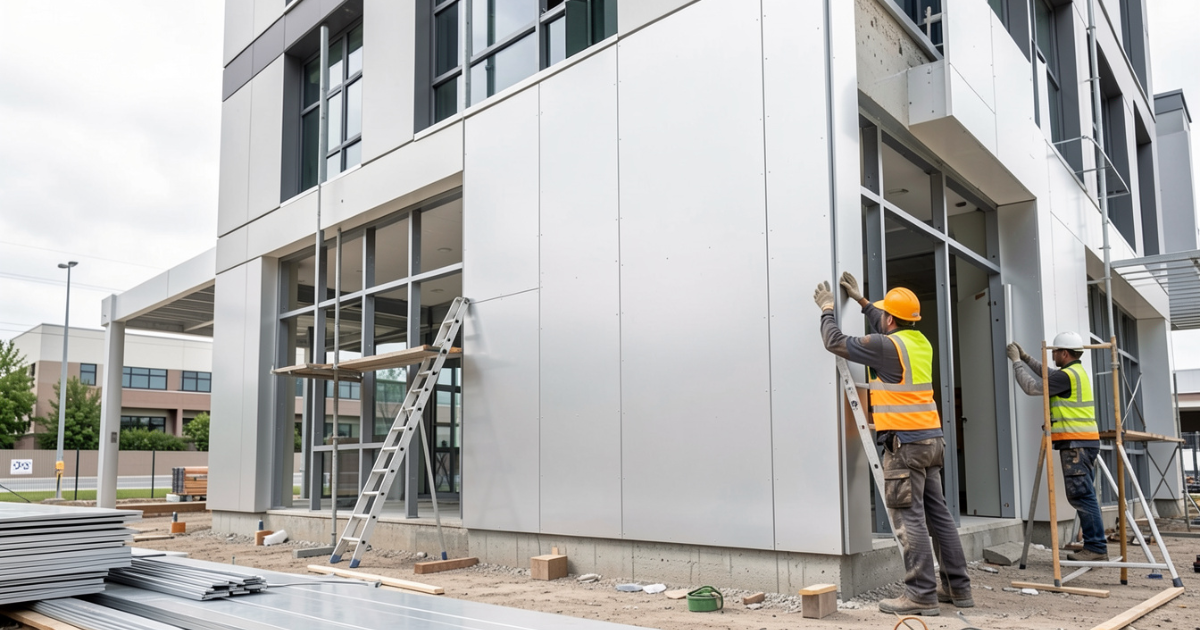
Fabricators usually spot the difference between good ACP and questionable ACP long before anyone else does.
Not on paper. Not in brochures. But right there on the workshop table.
You begin routing a panel. The fold line cracks slightly. The coating chips at the edge. Or the panel behaves beautifully and folds like it should. Clean. Predictable. Reliable.
Let’s be honest. That difference rarely happens by accident. It comes from how thoroughly the material has been tested before it even leaves the factory.
This is exactly where ACP quality tests for fabricators become critical. These tests are not abstract laboratory exercises. They directly affect how panels behave during routing, folding, bending and installation.
At Aludecor, every ACP panel goes through a structured evaluation framework of 205 different tests designed to understand material behaviour, durability and performance consistency.
Why so many? Because façade materials do not operate in ideal conditions. They face heat, rain, humidity, chemicals, wind loads and fabrication stress. If ACP sheets are not validated across these parameters, surprises appear later on site.
And no fabricator enjoys surprises during installation.
Which brings us to an important discussion across the façade industry today. The debate around Tested vs untested ACP sheets.
Understanding that difference is essential for fabricators who want consistent results and smoother projects.
What Is ACP Testing?
Before understanding the difference between tested and untested panels, it helps to know what ACP testing actually involves.
ACP testing is a structured evaluation process where aluminium composite panels are assessed for mechanical strength, coating durability, fire performance and environmental resistance. These tests follow internationally recognised methods such as ASTM, ISO and AAMA standards.
At Aludecor, testing starts right from the incoming raw materials. Aluminium coils, paints, plastic granules, adhesives and protective films all go through verification before they enter production.
And yes, the scope is extensive.
A reliable ACP manufacturer conducts ACP quality tests for fabricators at multiple stages of production. These include raw material inspection, in process verification and final product validation.
For example, aluminium coils are checked for alloy grade, hardness and thickness. These parameters ensure that the metal skin maintains proper mechanical strength and can withstand routing and folding during fabrication.
Mechanical performance is evaluated using instruments such as a Universal Testing Machine (UTM). This machine measures tensile strength, elongation and bonding integrity between aluminium skins and the core material.
And that bonding strength matters a lot. Because ACP is essentially a sandwich structure. Two aluminium skins bonded to a core. If this bond is weak, delamination can occur during fabrication or long-term exposure.
Coatings undergo another entire series of tests.
Paint viscosity, colour consistency, gloss level, scratch resistance and adhesion are all evaluated using methods like ASTM D523 for gloss measurement and ASTM D3359 for cross hatch adhesion.
Then there are durability tests. Accelerated weathering tests simulate years of sunlight and moisture exposure. In some cases, panels undergo 4,000 hours of UV weathering tests to predict long term outdoor performance.
When you look at this entire framework, it becomes quite clear why ACP sheet testing is important.
Because every stage of the panel’s life is being verified before it ever reaches a construction site.
All these evaluations form part of ACP quality tests for fabricators. And they answer one fundamental question.
Will the panel behave reliably during fabrication and installation?
This is precisely why ACP sheet testing is important for façade professionals.
Also Read: Why Choosing Tested ACP for high-rise buildings Is Essential for Your Apartment
Difference Between Tested and Untested ACP
On the surface, most ACP panels may look identical.
Same colours. Same finishes. Same thickness printed on specification sheets.
But behaviour under stress tells a different story.
The biggest difference in Tested vs untested ACP sheets lies in verification.
Tested ACP panels go through structured ACP quality tests for fabricators across raw material inspection, in process evaluation and final product validation.
Untested ACP panels often skip several of these checks.
Let’s take a simple example.
During production, panels are routinely checked for peel strength. This test measures how strongly the aluminium skins adhere to the core material. Panels are sometimes tested even after exposure to heat, boiling water or freezing conditions to ensure bonding remains stable
Material Behaviour
Fabricators often notice the difference while routing or folding.
Panels that pass ACP quality tests for fabricators bend smoothly without surface cracking. Core materials remain stable during folding.
Untested panels may show edge fractures, inconsistent folding behaviour or core brittleness.
Tested panels undergo scratch hardness tests, impact resistance tests and chemical exposure tests to ensure coatings do not crack or peel during fabrication or environmental exposure.
Untested panels may not go through such rigorous checks.
So while both materials may look similar initially, fabrication often reveals the real difference.
Performance Comparison: Key Metrics
To understand Tested vs untested ACP sheets, it helps to examine the key performance metrics evaluated during testing.
Bond Strength
Bond strength is tested using peel strength tests such as ASTM D903.
In some cases panels are tested after oven conditioning, boiling water exposure and freezing temperatures to verify that the aluminium skins remain firmly bonded to the core material.
Strong bonding ensures panels do not delaminate during routing or long term service.
Mechanical Strength
Mechanical tests evaluate tensile strength, yield strength and elongation of aluminium skins using ASTM E8 standards.
When these values are verified through ACP quality tests for fabricators, fabricators can route and fold panels without risking deformation. Without these tests, panels may crack during folding.
And that is exactly why ACP sheet testing is important.
Coating Adhesion
Paint coatings undergo several durability checks.
Tests include reverse impact testing (ASTM D2794), pencil hardness testing (ASTM D3363) and chemical resistance testing using acid and alkali solutions.
These evaluations ensure coatings remain intact during fabrication and exposure to environmental conditions.
Dimensional Consistency
Thickness, width and diagonal tolerances are measured repeatedly.
Panels meeting these parameters ensure accurate alignment during façade installation.
These performance checks collectively define the difference between Tested vs untested ACP sheets.
One is predictable. The other is uncertain.
Also Read: Tested vs Untested ACP: What’s the Real Difference in Performance?

Benefits of Using Tested ACP for Fabricators
Fabricators often discover the benefits of tested ACP materials firsthand.
When panels undergo proper ACP quality tests for fabricators, fabrication becomes significantly easier.
Reduced Material Wastage
When ACP sheets pass proper ACP quality tests for fabricators, dimensional accuracy improves.
Thickness, width and diagonal tolerances are checked repeatedly during production.
This consistency reduces rework and panel rejection during fabrication.
Reliable Fire Performance
For FR grade ACP panels, fire performance tests measure ignition behaviour, smoke density and oxygen index values.
These tests ensure that panels meet safety parameters required for modern buildings.
And frankly, that is a major reason why ACP sheet testing is important.
Because façade safety cannot rely on assumptions.
Faster Installation
Panels with consistent mechanical properties align more easily during installation.
Fabricators can maintain standard fabrication templates without constant adjustments.
And that improves project timelines significantly.
Also Read: Long-Term Cost vs Durability: Comparing Popular Exterior Wall Cladding Materials
Risks of Untested ACP in Projects
Using untested ACP sheets may initially appear cost effective.
But the risks often surface later.
Delamination Risk
Weak bonding between aluminium skins and core materials can lead to delamination during fabrication or after installation.
Peel strength tests help identify this risk in advance.
Without such tests, problems appear only after panels are installed.
Coating Failure
Untested coatings may crack during folding or fade prematurely under sunlight exposure.
Accelerated weathering tests are specifically designed to predict this behaviour.
This is another reason why ACP sheet testing is important for façade durability.
Fabrication Difficulties
Inconsistent metal hardness or core composition may cause unexpected behaviour during routing.
Panels may crack, warp or resist clean folding.
This increases fabrication time and material wastage.
Long Term Performance Uncertainty
Without structured ACP quality tests for fabricators, it becomes difficult to predict how panels will behave after installation.
And that uncertainty can affect the entire façade system.
And that is why discussions around Tested vs untested ACP sheets are not theoretical debates. They influence real world project outcomes.

When Testing Becomes the Fabricator’s Best Friend
At the end of the day, fabrication workshops operate on precision. Panels must bend accurately. Coatings must remain intact. Installations must align perfectly with design drawings.
And materials must behave consistently.
This is why ACP quality tests for fabricators matter so much in façade construction. They provide measurable assurance that panels will perform exactly as expected during routing, folding and installation.
Using tested materials reduces fabrication uncertainties. It improves efficiency. It protects project timelines.
And more importantly, it ensures that the final façade performs reliably for years.
When comparing Tested vs untested ACP sheets, the difference becomes clear very quickly once fabrication begins.
Testing may happen inside laboratories. But its benefits are experienced directly on the workshop floor.
Call us at 1800-102-0407 or visit aludecor.com/enquiry to explore ACP solutions designed for performance and long-term aesthetic value.
FAQ Section
Does using tested ACP reduce long term project risks?
Yes, panels that pass structured ACP quality tests for fabricators have verified mechanical strength, coating durability and bonding stability.
These tests simulate fabrication stress, environmental exposure and long-term performance conditions. As a result, projects using tested ACP materials experience fewer installation issues, lower maintenance requirements and improved façade durability.
This is one of the primary reasons why ACP sheet testing is important for large scale construction projects.
How does testing impact the installation process?
Testing ensures dimensional consistency and mechanical reliability.
Parameters like panel thickness, width, bonding strength and coating durability are evaluated during production. These checks allow fabricators to route and fold panels accurately without unexpected defects.
Panels that meet ACP quality tests for fabricators therefore install more easily and align better with façade substructures.
Installation becomes faster and more predictable.
Can untested ACP be used for high-rise projects?
Using untested ACP in high rise buildings is strongly discouraged.
High rise façades face multiple environmental stresses including wind pressure, temperature variations, UV exposure and moisture.
Without validated ACP quality tests for fabricators, it is difficult to confirm whether panels will maintain structural integrity and fire safety performance under these conditions.
For safety and long-term durability, tested ACP panels that meet recognised standards should always be preferred in high rise projects.
This is one of the most important reasons why ACP sheet testing is important in modern façade construction.