Modern architecture is increasingly defined by its pursuit of stronger, lighter, and more sustainable materials that can support ambitious design vision without compromising structural performance. As India’s infrastructure expands across high-rise buildings, transport terminals, urban institutions and envelope-driven façade systems, architects are reconsidering conventional material choices. In this evolving landscape, the role of honeycomb panels is becoming central to durable construction. Their unique cellular geometry, exceptional rigidity-to-weight ratio, and long-term environmental resilience align with contemporary performance expectations for exterior and interior systems alike.
As India’s most tested and trusted ACP, Aludecor continues to reference advanced material technologies – including honeycomb core systems – while engineering facade and cladding products that integrate strength, durability, and precision. With growing interest in lightweight composite cladding, this article explores the structural and environmental advantages of honeycomb sheets and examines why they are increasingly preferred for modern architectural applications.
Also Read: Aludecor Unveils Nexcomb Aluminium Honeycomb Panels in India
Understanding Honeycomb Sheets and Their Core Structure
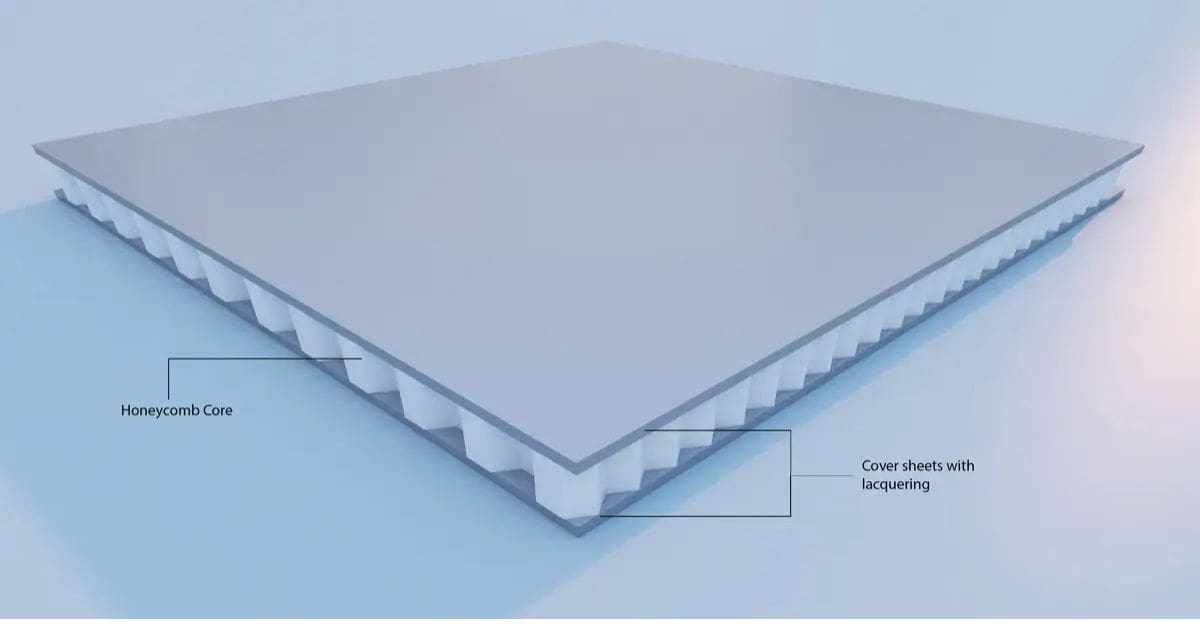
To appreciate the expanding role of honeycomb panels, it is essential to understand the geometry that powers them. Honeycomb sheets consist of two aluminium skins bonded to a hexagonal core -mirroring the cellular structure found in nature, especially in honeycombs crafted by bees. This hexagonal pattern distributes load evenly, prevents buckling, and delivers exceptional stiffness despite low material consumption.
How Honeycomb Panels Are Engineered
The manufacturing process typically includes:
- Formation of a hexagonal aluminium core i.e. Nexcore through precision glue-bonding and fully automated roll-forming
- Automated bonding of aluminium skins ensuring uniform adhesion
- High-precision assembly systems that guarantee tight tolerances across the panel surface
Advanced systems such as Aludecor’s integrated fully automated roll-forming and glue-dispensing technology ensure optimum core bonding, consistent cell geometry, and superior panel flatness.
This understanding establishes why understanding honeycomb panels is crucial for architects seeking material efficiency without compromising load-bearing behaviour.

Engineering Strength: How Honeycomb Technology Enhances Durability
The distinctive structure of honeycomb sheets gives them mechanical properties that outperform many conventional cladding materials. The vertical walls of the hexagonal core behave like miniature I-beams, resisting compression, bending, and shear forces.

Structural Advantages
Key strength attributes include:
- High stiffness with very low weight
- Excellent resistance to bending and buckling
- Dimensional stability over large panel sizes
- Superior impact resistance compared to MDF, plywood, and polymer cores
Engineered systems like Nexcomb (powered by Nexcore) achieve these properties through optimised bonding processes that ensure perfect adhesion between skins and core. This is a crucial factor in exploring honeycomb structures for high-performance façades.
Why do honeycomb panels offer superior strength?
Honeycomb cores distribute loads evenly across hexagonal cells, eliminating local stress points. This geometric behaviour reduces deformation, resulting in a lightweight yet structurally robust panel capable of supporting large spans without reinforcement.
Weather and Environmental Resistance for Long-Term Performance
One defining characteristic behind the growing role of honeycomb panels is their ability to withstand diverse climate conditions, especially in India’s extreme environments – from monsoon-driven coastal belts to hot, dry regions and high-pollution urban centres.
Key Environmental Resistances
- Moisture resistance: the aluminium skins prevent absorption, warping, or distortion
- UV stability: coated surfaces resist colour fading or chalking
- Wind-load capacity: the rigid core enhances performance in high-rise applications
- Corrosion resistance: aluminium alloys and protective coatings offer long-term durability
How do honeycomb panels perform in heavy rainfall regions?
Honeycomb aluminium panels maintain their structural integrity in humid or high-rainfall zones because the core does not absorb moisture and the aluminium skins resist corrosion. Ventilated mounting systems further improve water drainage.
Fire, Moisture, and Thermal Advantages of Honeycomb Panels
Fire safety remains a critical requirement in modern façade design. Honeycomb sheets, particularly those engineered for fire performance, offer advantages that surpass MDF, plywood, or polymer-based composites.
Fire Performance
Honeycomb panels can meet stringent classifications such as A2-s1, d0, meaning:
- No flame spread
- Negligible smoke development
- Zero flaming droplets
Their hexagonal aluminium core acts as a barrier, slowing heat transfer and improving evacuation safety – an essential aspect in understanding the role of honeycomb panels for high-rise buildings.
Thermal Efficiency
The trapped air pockets inside the honeycomb structure provide thermal insulation. This helps stabilise internal temperatures and reduces HVAC loads.
Moisture Behaviour
Unlike fibre-based cores, honeycomb sheets:
- Do not swell
- Do not delaminate in humidity
- Retain form in freeze-thaw cycles
These advantages strengthen their use in façades, ceilings, canopy systems, and transport infrastructure.
Design Flexibility for Modern Architectural Concepts
Contemporary architecture demands materials that support creative freedom. Honeycomb sheets deliver versatility through their structural configuration and lightweight composition.
Capabilities that Support Innovative Design
- Panel thickness flexibility: 6 mm to 100 mm
- Curved surface compatibility: 300 mm to 2,000 mm radii
- Lightweight strength for large panels
- Compatibility with CNC routing and shaping tools
These features enable architects to incorporate parametric façades, deep reveals, cantilevered claddings, and large-format panels – making exploring honeycomb structures vital to next-generation design.
Can honeycomb panels be curved for façade applications?
Yes. Due to their structural flexibility and low weight, honeycomb sheets achieve large curvatures without compromising rigidity, supporting complex geometries in airports, malls, and public architecture.
Sustainability Benefits and Lifecycle Efficiency
Sustainability is integral to modern design, and the role of honeycomb panels aligns strongly with environmental priorities.
Key Environmental Advantages
- Low material consumption: geometric efficiency reduces metal usage
- Long service life: fewer replacements and reduced waste
- Full recyclability: aluminium skins and honeycomb cores can be recycled repeatedly
- Lower embodied carbon: many honeycomb systems record as low as 4–7 kg CO₂e/m²
Compared to a 3 mm solid aluminium sheet (9–11 kg CO₂e/m²) or 4 mm ACP panels (10–13 kg CO₂e/m²), honeycomb sheets significantly reduce carbon footprint, making them suitable for green-certified buildings.
Key Applications of Honeycomb Sheets in Architecture
Honeycomb panels are increasingly used across architectural and infrastructural domains because of their durability and weight efficiency.
Exterior Applications
- High-rise façades
- Roof soffits and canopies
- Corporate towers and IT parks
- Public buildings and transport terminals
Interior Applications
- Interior cladding
- Column and beam wraps
- Lift lobbies and circulation areas
- Ceiling panels
Hybrid and Composite Applications
Honeycomb sheets integrate seamlessly with:
- Stone
- ACP sheets
- Glass fins
- Metal louvers
This compatibility makes them versatile components in façade engineering systems.
Conclusion
Honeycomb panel technology represents a significant advancement in architectural material science. With its superior strength-to-weight ratio, fire-safe performance, long-term environmental durability, and exceptional design flexibility, honeycomb cladding has become indispensable in façade engineering. The expanding role of honeycomb panels reflects a shift toward materials that deliver structural reliability and lifecycle efficiency while supporting expressive modern architecture.
As India’s most tested and trusted ACP, Aludecor continues to parallel these engineering principles through its commitment to precision manufacturing, sustainable material use, and high-performance façade systems. Honeycomb technologies such as Nexcomb align seamlessly with the future of architecture where sustainability, durability, and design freedom converge.
📞 Call Aludecor’s toll-free support at 1800-102-0407
🌐 For more details and expert advice visit https://nexcomb.com/request-form/
FAQs
- What makes honeycomb sheets more durable than conventional cladding materials?
Their hexagonal core distributes load evenly, providing high stiffness and resistance to bending, moisture, and impact. This geometry ensures long-term structural stability even in large-format applications.
- Are honeycomb panels suitable for high-rise building façades?
Yes. Their lightweight yet rigid structure enhances wind-load performance, making them ideal for high-rise façades, cantilevered systems, and ventilated cladding assemblies.
- How do honeycomb sheets perform in extreme weather conditions?
They remain dimensionally stable under UV exposure, temperature fluctuations, humidity, and heavy rainfall. The non-absorbent aluminium core prevents swelling or delamination.
- Can honeycomb panels be customised in terms of finish and design?
Yes. They are compatible with PVDF, FEVE, and specialised coatings and support curved, folded, and CNC-shaped geometries for advanced architectural concepts.