


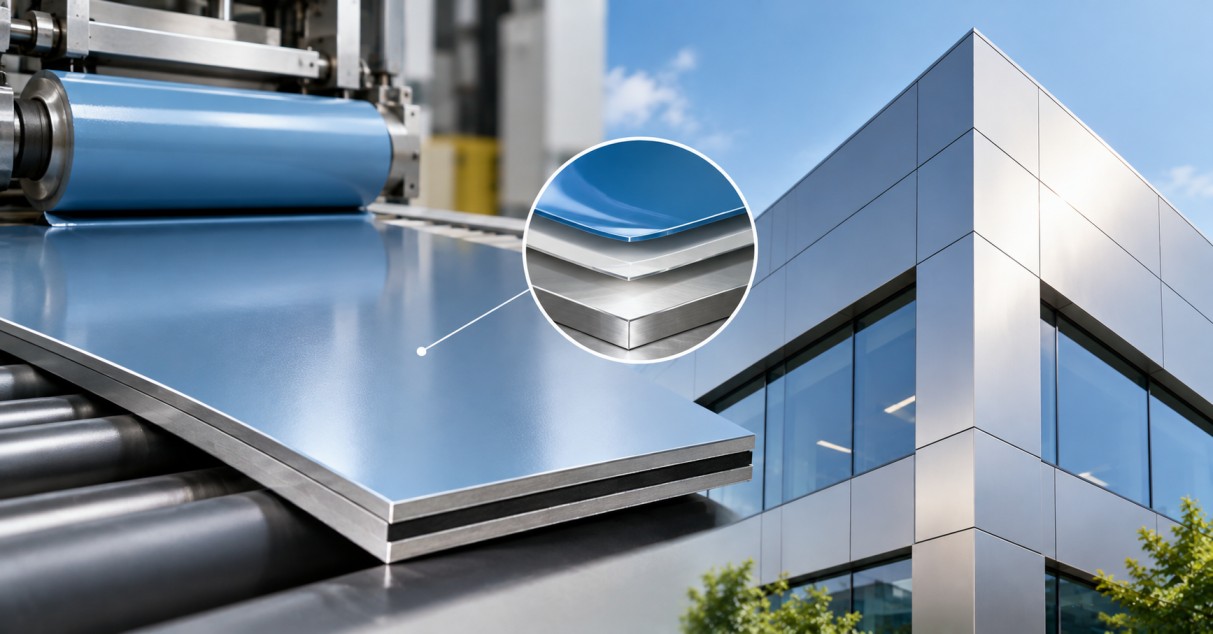
When a building is designed, everyone talks about the façade. The finish. The aesthetics. The statement it makes. But very few people stop to ask a simple question. How will that façade look after ten, twenty or even thirty years?
Let’s be honest. A façade is exposed to everything nature can throw at it. Harsh ultraviolet radiation. Heavy rainfall. Coastal salt spray. Industrial pollutants. Dust. Temperature fluctuations. Acid rain. If the surface protection isn’t engineered to withstand these conditions, even the most stunning building can begin to lose its charm much sooner than expected.
That is precisely where PVDF coating becomes important. In aluminium composite panels (ACP), the paint system is not merely decorative. It is a protective barrier that determines how well the panel resists fading, chalking, corrosion and weathering over decades of exposure. A high-performance PVDF coating ensures that the façade continues to retain its colour, gloss and structural integrity long after installation.
At Aludecor, we often say that a landmark should continue looking like one, not just on inauguration day but for generations to come. That philosophy is exactly why we continue to invest in premium PVDF coating technologies that deliver lasting performance. High PVDF content helps lock pigments firmly, enabling façades to retain their colour and gloss for decades under appropriate exposure conditions.
So, what exactly is PVDF coating? How is it applied? And why do architects across the world continue to specify it for premium exterior façades? Let’s understand.
What Is PVDF Coating?
The PVDF coating full form is Polyvinylidene Fluoride.
It is a fluoropolymer resin recognised globally for its exceptional resistance to weathering, ultraviolet radiation, chemicals and environmental degradation. Because of these characteristics, PVDF coating has become the preferred paint system for exterior aluminium building products, including ACP sheets.
Unlike ordinary polyester paints that may deteriorate with prolonged exposure, PVDF coating forms an extremely stable molecular structure. The carbon-fluorine bond within the polymer is among the strongest chemical bonds known, making it remarkably resistant to sunlight, oxidation and chemical attack.
In simple words, it is the reason why premium façades continue to look premium after decades.
Internationally, high-performance PVDF paints are generally manufactured in accordance with standards such as AAMA 2605 and are widely preferred for demanding architectural applications where colour retention and weather resistance are critical.
| Feature | PVDF Coating | Polyester Coating |
|---|---|---|
| UV Resistance | Excellent | Moderate |
| Colour Retention | Excellent | Fair |
| Gloss Retention | Excellent | Moderate |
| Exterior Life | Long | Shorter |
| Coastal Use | Yes | Limited |
How PVDF Coating Is Applied to ACP Panels
Applying PVDF coating is a highly controlled industrial process rather than a conventional painting operation. The aluminium coil first undergoes extensive surface preparation, including cleaning, degreasing and chemical pretreatment. This stage is critical because coating performance depends heavily on surface cleanliness.
The prepared aluminium coil then moves through a continuous coil coating line where successive layers are applied. A typical architectural PVDF paint system consists of:
- Pretreatment layer
- Primer coat
- PVDF coating
- Protective clear coat (where applicable)
Each layer is cured inside high-temperature ovens under carefully monitored conditions to achieve proper cross-linking and adhesion.
Only after the coating has completely cured is the aluminium laminated with the ACP core to manufacture aluminium composite panels.
The result is a highly durable finish that becomes an integral part of the aluminium surface rather than simply sitting on top of it.
Why PVDF Coating Is Important for ACP Panels
The importance of PVDF coating becomes obvious when a building has been standing for several years. Buildings are constantly exposed to:
- Ultraviolet radiation
- Rainfall
- Moisture
- Acid rain
- Coastal salinity
- Industrial pollutants
- Dust accumulation
- Temperature cycles
These are exactly the conditions that ACP façades are expected to resist. Premium ACP façades should withstand UV radiation, acid rain, moisture and industrial pollutants throughout their service life.
Without an advanced PVDF coating, these environmental factors gradually begin affecting the surface. The consequences may include:
- Colour fading
- Loss of gloss
- Chalking
- Surface cracking
- Reduced aesthetic appeal
- Higher maintenance requirements
For architects specifying landmark projects, these risks are unacceptable.
This is why PVDF coating remains the preferred finish for airports, hospitals, commercial towers, educational institutions, corporate offices and premium residential developments.
Also Read: Explore Aludecor’s 600+ ACP Sheet Colour Shades for Limitless Design Possibilities
Key Features of PVDF-Coated ACP Panels
Outstanding UV Resistance
Sunlight is one of the biggest enemies of exterior coatings. The fluoropolymer chemistry of PVDF coating significantly slows down pigment degradation, allowing façades to maintain colour consistency over extended periods.
Excellent Weather Resistance
Whether installed in deserts, coastal cities or regions with heavy rainfall, PVDF coating performs consistently across varying climatic conditions. It resists:
- Rain
- Humidity
- Wind
- Snow
- Heat
- Temperature fluctuations
Superior Colour Retention
One of the biggest advantages of premium PVDF coating is its ability to maintain vibrant colours.
At Aludecor, an awareness campaign demonstrates this beautifully with the thought that even “the grandson finds the same gloss”, illustrating how PVDF content helps preserve appearance for up to 30–40 years under suitable conditions.
High Gloss Retention
Loss of gloss is often the first visible sign of façade ageing. A premium PVDF coating helps maintain surface brilliance for many years, reducing the dull appearance commonly seen in inferior paint systems.
Excellent Chemical Resistance
Industrial emissions and acid rain can gradually attack conventional coatings. Because PVDF coating possesses exceptional chemical stability, it offers strong resistance against:
- Acid rain
- Industrial chemicals
- Atmospheric pollutants
Low Dirt Pickup
The smooth surface created by PVDF coating reduces dirt adhesion. Rainwater naturally washes away much of the accumulated dust, helping façades stay cleaner between maintenance cycles.
Advantages of PVDF Coating in ACP Panels
Selecting PVDF coating offers both aesthetic and lifecycle advantages.
Long-Term Visual Appeal
Buildings retain their original appearance much longer, reducing the need for repainting or premature replacement.
Lower Maintenance Costs
Because colour fading and surface degradation occur much more slowly, maintenance frequency is significantly reduced.
Better Return on Investment
Although premium PVDF coating may involve a higher initial investment, its extended service life often makes it the more economical choice over the building’s lifecycle.
Suitable for Landmark Projects
Premium commercial developments, airports, institutional buildings and luxury residences frequently specify PVDF coating because appearance matters for decades, not merely during project handover.
Better Resistance to Harsh Environments
Coastal locations, industrial zones and high UV exposure regions demand coatings capable of resisting aggressive environmental conditions.
Here, PVDF coating consistently outperforms conventional exterior paint systems.
How to Identify High-Quality PVDF-Coated ACP Sheets
Not every panel marketed as PVDF offers identical performance.
Here are several factors that architects and buyers should evaluate.
Check the Paint System
Ask whether genuine architectural-grade PVDF coating has been used.
Verify Standards
Ensure the manufacturer complies with internationally recognised coating standards wherever applicable.
Evaluate Manufacturer Credibility
The coating performs only as well as the manufacturing process behind it.
At Aludecor, we combine advanced manufacturing practices with rigorous quality testing because long-term façade performance depends on process consistency as much as paint chemistry.
Ask About Warranty
A reputable manufacturer should confidently stand behind the durability of its PVDF coating through appropriate product warranties.
Review Testing Credentials
Perhaps the most important question is this: Has the product actually been tested?
At Aludecor, we believe trust should be earned through evidence, not promises. That philosophy is at the heart of our #TestNahiTohTrustNahi campaign, which encourages the industry to verify product performance before making a choice.
Every Aludecor ACP undergoes 205 rigorous in-house quality and performance tests, covering parameters such as coating performance, weather resistance, structural integrity, adhesion, durability and fire performance. But we didn’t stop there.
Through our Join the Trust Movement, we have launched India’s largest free ACP testing initiative, where architects, fabricators, builders and consultants can submit ACP samples of any brand for testing at no cost. The objective is simple: help the industry make informed decisions based on scientific testing rather than assumptions or promotional claims. You can learn more or register for free testing through the Join the Trust Movement. The initiative reflects our belief that transparency strengthens the entire façade industry, not just one brand.
Because when it comes to a façade that’s expected to last for decades, one principle should always apply: Test Nahi Toh Trust Nahi.
Conclusion
The paint applied to an ACP panel is far more than a finishing touch. It is the façade’s first line of defence against decades of environmental exposure.
Understanding the PVDF coating full form is only the beginning. The real value lies in appreciating how this advanced fluoropolymer technology protects buildings from ultraviolet radiation, pollution, moisture, chemical exposure and colour degradation.
At Aludecor, we believe that buildings deserve to remain visually striking long after the ribbon-cutting ceremony. That is why we continue to engineer ACP solutions with premium PVDF coating, enabling architects, developers and building owners to create façades that continue to inspire confidence for decades.
Because in architecture, lasting beauty isn’t an accident. It is engineered.
Frequently Asked Questions
What does PVDF stand for in ACP panels?
The PVDF coating full form is Polyvinylidene Fluoride. It is a high-performance fluoropolymer coating widely used on aluminium composite panels because of its outstanding resistance to ultraviolet radiation, weathering, chemicals and environmental ageing. Its exceptional molecular stability enables ACP façades to maintain their colour, gloss and appearance over extended periods.
Why is PVDF coating preferred for exterior ACP applications?
PVDF coating is preferred because exterior façades are continuously exposed to sunlight, rain, pollution, moisture, temperature variations and other environmental stresses. Unlike conventional coatings, PVDF provides excellent UV resistance, superior colour retention, gloss retention and weather resistance, making it ideal for commercial buildings, airports, hospitals, educational institutions and premium residential developments.
How long does PVDF coating last on ACP sheets?
The actual service life depends on product quality, environmental exposure and maintenance practices. However, high-quality PVDF coating systems are widely recognised for retaining colour and gloss for decades. High PVDF content can help maintain vibrant colours and gloss for approximately 30 to 40 years under appropriate service conditions.
Is PVDF coating suitable for coastal environments?
Yes. PVDF coating is particularly well suited for coastal applications because it offers excellent resistance to moisture, salt-laden air, ultraviolet radiation and harsh weather conditions. When combined with quality aluminium substrates and proper installation practices, it helps façades withstand challenging coastal environments while maintaining their appearance for many years.


