


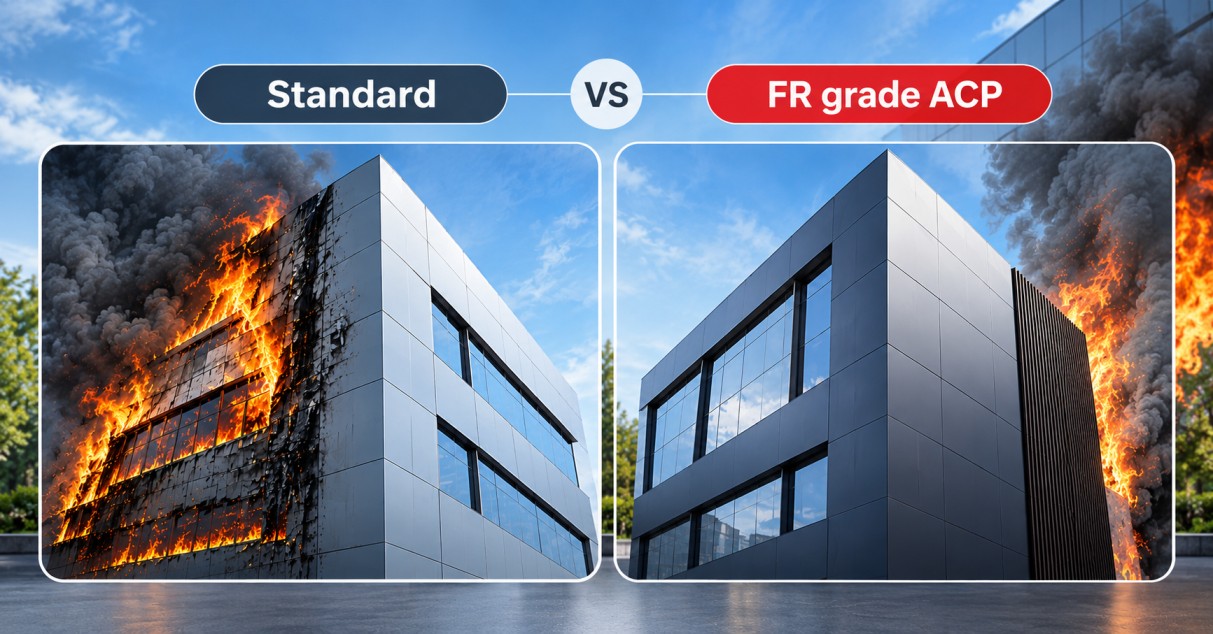
When selecting façade materials for a project, one question almost always comes up: should you go for standard ACP or invest in FR grade ACP?
For many developers and contractors, the first instinct is to compare prices. Standard ACP sheets are cheaper upfront, widely available, and often considered “good enough” for exterior applications. But façades are not just decorative skins. They directly influence building safety, durability, compliance, and long-term maintenance.
That changes the conversation completely.
As cities grow denser and buildings rise taller, fire safety has become impossible to ignore. Regulatory standards such as EN 13501-1 and DIN 4102 are pushing the industry towards safer cladding specifications. And this is where FR grade ACP starts justifying its higher cost.
Because sometimes, saving on material cost can become very expensive later.
Understanding Standard ACP and FR Grade ACP
Standard ACP generally consists of aluminium skins bonded to an LDPE (Low Density Polyethylene) core. While lightweight and economical, the core remains combustible.
FR grade ACP, however, contains mineral-rich inorganic content designed to slow flame spread, reduce smoke emission, and minimise heat release during a fire.
Under EN 13501-1, FR ACP is mainly classified into:
- Class B-s1, d0
- Class A2-s1, d0
Class B panels contain over 72% inorganic content and are self-extinguishing with limited flame spread. A2 panels contain over 90% inorganic content and offer significantly higher fire performance with minimal smoke and zero flaming droplets.
Both products may carry the “FR” label in the market, but their actual fire behaviour can be vastly different.
At Aludecor, our Firewall series is developed with in-house pelletised mineral cores and tested under internationally recognised standards to ensure consistent fire performance.
What Drives the Cost of ACP Sheets?
The price difference between standard ACP and FR grade ACP comes from the materials, manufacturing complexity, testing, and certification involved.
1. Price Components of Standard ACP Sheets
Standard ACP sheets use polyethylene-heavy cores, making them cheaper to manufacture. The process is simpler, and certification requirements are less extensive.
For low-risk applications, they may still offer acceptable aesthetics and weather resistance. But the concern lies in how the panel behaves during a fire incident. The appearance of a panel does not reveal its fire performance.
2. Price Components of FR Grade ACP Sheets
FR grade ACP involves far more engineering.
Its core contains fire-retardant minerals such as Aluminium Tri Hydroxide (ATH) and Magnesium Di Hydroxide (MDH), which help suppress combustion through endothermic reactions.
Then comes the testing.
- Flame spread
- Heat release
- Smoke density
- Fire growth rate
- Flaming droplets
The aforementioned parameters are evaluated under standards including EN 13501-1, ASTM E119-12, NFPA 285, and DIN 4102.
Naturally, these additional processes increase manufacturing costs.
At Aludecor, we operate India’s first NABL-accredited in-house FR testing laboratory along with an in-house pelletising line. Every pelletised lot is tested before production. That level of quality control adds reliability, but yes, it also adds cost.
Key Performance Differences That Influence Value
Comparing ACP sheets purely on purchase price rarely gives the full picture.
Performance over the building’s lifecycle matters far more.
Fire Safety Benefits of FR Grade ACP
This is where FR ACP creates the biggest difference.
Standard ACP with LDPE core can contribute significantly to flame spread and heat release. FR ACP panels are specifically designed to delay ignition, reduce smoke generation, and prevent flaming droplets from accelerating fire propagation.
Under EN standards:
- FR Class B panels maintain heat release below 13 MJ
- FR A2 panels maintain heat release below 3 MJ
That difference becomes critical during evacuation.
Let’s be honest. In most fire incidents, smoke inhalation causes more fatalities than direct flames. FR ACP producing low smoke density improves visibility and evacuation conditions during emergencies.
And for high-rise buildings, this becomes extremely important.
Durability and Long-Term Maintenance Impact
There’s another aspect people often overlook – durability.
Premium FR ACPs are generally manufactured with superior alloys, denser mineral cores, and advanced coating systems. At Aludecor, our AL45 panels utilise AA5005 and AA3105 alloy skins with advanced PVDF coatings using a 70:30 resin ratio similar to Kynar 500 systems.
This improves:
- Colour retention
- Weather resistance
- Surface stability
- Structural durability
Which eventually reduces long-term maintenance concerns.
So, while FR ACP costs more initially, it often delivers stronger long-term value.
Risk Factor in Using Non-FR ACP
Using non-FR ACP in high-risk structures can create major liabilities.
Buildings with high occupancy or vertical fire spread risk require façade materials with certified fire-retardant performance. Standard ACP may lead to:
- Faster flame propagation
- Excessive smoke generation
- Flaming droplets
- Greater façade failure risk
In some projects, non-compliance with fire norms can also affect approvals, insurance, and project accountability.
The short-term savings can disappear instantly after one incident.
Lifecycle Cost vs Initial Purchase Cost
A façade should never be judged only by cost per square metre. The smarter approach is lifecycle costing.
While standard ACP may reduce upfront expenditure, future costs related to:
- Safety upgrades
- Retrofitting
- Maintenance
- Replacement
- Compliance risks
can outweigh the initial savings.
FR grade ACP delivers long-term value because it combines fire safety, durability, and compliance within one system.
And honestly, the industry is steadily moving towards this mindset already.
Where FR Grade ACP Becomes Mandatory
High-rise Buildings
For high-rise projects, especially above 10 floors, A2-grade ACP is increasingly preferred because of its superior reaction-to-fire behaviour and low heat release.
Vertical fire spread risk is much higher in tall structures, making safer façade materials essential.
Commercial Complexes
Shopping malls, office towers, hotels, and mixed-use developments involve heavy footfall and complex evacuation conditions.
FR grade ACP helps reduce fire propagation risk while aligning with modern safety expectations.
Public Infrastructure
Hospitals, airports, metro stations, and educational institutions require stricter safety specifications due to occupancy density and evacuation sensitivity.
In such projects, certified FR ACP becomes a responsible specification rather than a premium upgrade.
Is the Higher Cost of FR ACP Justified?
In most cases, yes.
The cost difference between standard ACP and FR ACP is usually a small fraction of the total project budget. But the difference in safety performance can be enormous.
You are not just paying for a panel. You are paying for:
- Certified fire performance
- Reduced smoke generation
- Lower heat release
- Better evacuation safety
- Compliance confidence
- Long-term façade reliability
At Aludecor, we believe fire safety should never rely on assumptions or marketing claims. It must be verified through testing, certification, and disciplined manufacturing.
That is why our Firewall series is backed by internationally recognised certifications, in-house testing infrastructure, and continuous quality monitoring.
How to Choose the Right ACP?
The debate between standard ACP and FR grade ACP is not simply about cheaper versus costlier materials.
It is about deciding what level of safety and long-term performance your building deserves.
Standard ACP may still suit certain low-risk applications. But for high-rise buildings, commercial developments, and public infrastructure, FR grade ACP has become the more responsible and future-ready choice.
Because once a building is complete, people rarely remember how much money was saved on the façade.
But they always remember whether safety was compromised.
Call us at 1800 102 0407 or visit aludecor.com/enquiry to explore ACP solutions designed for performance and long-term aesthetic value.
FAQs
Why is FR grade ACP more expensive than standard ACP?
FR grade ACP uses mineral-rich fire-retardant cores instead of conventional polyethylene cores. It also undergoes extensive testing and certification under standards such as EN 13501-1 and NFPA 285, increasing manufacturing and quality control costs.
Is FR ACP mandatory for high-rise buildings?
In many high-rise projects, FR ACP is strongly recommended or mandatory depending on local fire norms and consultant specifications. A2-grade ACP is increasingly preferred for buildings above 10 floors.
Does FR ACP offer better durability than standard ACP?
Premium FR ACP panels often provide better weather resistance, colour retention, and structural stability due to superior alloys, denser cores, and advanced coating systems.
Can standard ACP be used for exterior façades?
Standard ACP may still be suitable for certain low-risk and low-rise applications where regulations permit. However, FR ACP is strongly recommended for commercial, public, and high-rise projects because of its improved fire safety performance.


