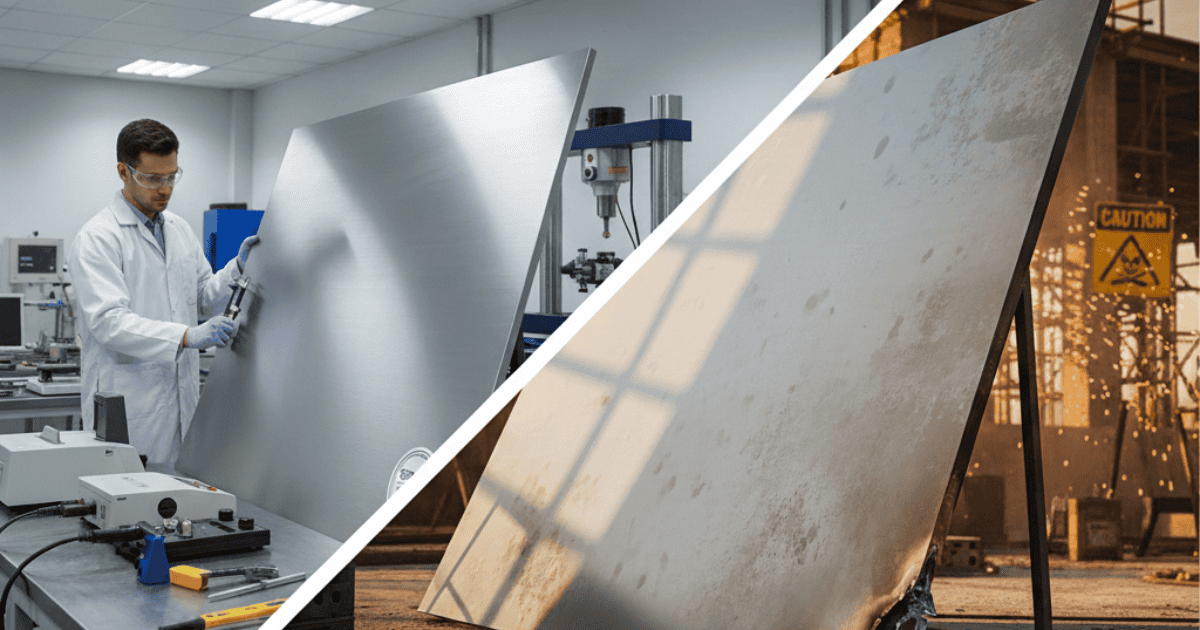
Aluminium Composite Panels (ACP) have become a defining material in modern façades. They are lightweight, versatile, and visually adaptable, making them a preferred choice for commercial buildings, high-rise residences, transport infrastructure, and institutional projects across India. Yet, despite their widespread use, not all ACP panels perform the same way once installed.
The critical distinction lies in tested vs untested ACP.
On the surface, both may look identical. Thickness, colour, gloss, and even datasheets can appear similar. However, the real difference emerges over time, under heat, fire exposure, wind pressure, humidity, pollution, and continuous UV radiation. This is where systematic testing separates predictable performance from hidden risk.
Understanding the difference between tested and untested ACP is no longer optional for architects, builders, or government authorities. It directly affects fire safety, façade durability, lifecycle cost, and regulatory accountability. This article explains what ACP testing actually involves, how performance is validated, and why ACP sheet performance comparison must go beyond visual inspection or price.
What Is ACP Testing?
ACP testing is a structured process that evaluates how a panel behaves across its entire lifecycle, from raw material quality to long-term exposure conditions. It is not a single test, nor is it limited to finished panels.
Comprehensive ACP testing typically includes:
- Raw material verification (aluminium coils, coatings, core materials)
- In-process quality checks during manufacturing
- Finished product performance tests
- Long-term weathering and durability simulations
In a tested system, performance is verified repeatedly, not assumed once. In contrast, untested ACP products often rely on limited or selective test reports that may not reflect real-world behaviour.
This foundational difference defines the debate around tested vs untested ACP.
Difference Between Tested and Untested ACP
The difference between tested and untested ACP lies in consistency, traceability, and predictability.
Tested ACP panels:
- Are evaluated at multiple stages of production
- Use defined test standards (ASTM, EN, BIS)
- Demonstrate repeatable results across batches
- Have documented behaviour under fire and weather exposure
Untested ACP panels:
- May only be tested once, or not at all
- Often rely on supplier declarations
- Show batch-to-batch variation
- Carry higher long-term risk despite lower upfront cost
In façade systems, small material inconsistencies scale into large failures. What begins as minor adhesion loss or coating instability can result in delamination, fading, corrosion, or unsafe fire behaviour years after installation.
Also Read : Why Tested ACP Panels Are Safer Than Untested Ones

Key Performance Metrics in ACP Evaluation
A meaningful acp sheet performance comparison focuses on how panels behave under critical stress conditions.
Fire Safety
Fire performance is the most scrutinised parameter in façade materials.
Tested ACP panels undergo reaction-to-fire testing under standards such as:
- EN 13501-1
- ASTM E119 / E84
- BIS fire-related norms
These tests evaluate:
- Flame spread
- Smoke generation
- Flaming droplets
- Heat release behaviour
Untested ACP panels may claim “FR” status without validated core composition or system-level testing. In fire scenarios, this can result in rapid flame propagation and toxic smoke generation.
This is why tested vs untested ACP is fundamentally a life-safety issue, not just a compliance checkbox.
Colour & Fade Resistance
ACP façades are continuously exposed to sunlight and pollution.
Tested panels undergo:
- Accelerated QUV weathering
- Humidity resistance testing
- Open-sky exposure studies
These tests predict:
- Colour retention
- Gloss stability
- Coating chalking
- Surface degradation
Untested ACP panels often show early fading or patchy discolouration, particularly on sun-facing façades. Once installed, corrective action is costly and disruptive.

Impact & Structural Strength
ACP panels must withstand wind pressure, handling stress, and accidental impact.
Tested ACP panels are evaluated for:
- Peel strength (bonding integrity)
- Impact resistance
- Flexural and tensile behaviour
These tests ensure that aluminium skins remain bonded to the core under mechanical stress.
Untested ACP panels may delaminate silently, with failure becoming visible only when panels detach or deform, posing safety and liability risks.
Corrosion & Weather Resistance
Indian environments subject façades to:
- High humidity
- Coastal salinity
- Industrial pollution
- Temperature variation
Tested ACP panels undergo:
- Salt spray testing
- Thermal cycling
- Humidity exposure tests
These simulate years of environmental stress. Untested panels may pass visual inspection initially but corrode or blister over time.
Also Read : ACP Testing Standards Guide: What Each Test Really Measures

Comparison: Tested vs Untested ACP Panels
Before choosing ACP based on appearance or cost, it is essential to evaluate how performance is verified. The table below highlights the practical ACP sheet performance comparison between tested and untested panels.
| Parameter | Tested ACP Panels | Untested ACP Panels |
| Fire behaviour | Verified under global standards | Often unverified or selective |
| Batch consistency | Controlled and repeatable | Variable |
| Peel strength | Tested and documented | Not consistently tested |
| Colour durability | Proven through weathering tests | Unpredictable |
| Corrosion resistance | Simulated and validated | Often assumed |
| Regulatory acceptance | Widely accepted | Frequently questioned |
| Lifecycle cost | Predictable | High risk of replacement |
This comparison underscores why the difference between tested and untested ACP becomes critical in large-scale and public-facing projects.
Benefits of Using Tested ACP Panels
Choosing tested ACP panels delivers measurable advantages across the building lifecycle.
Key benefits include:
- Reduced façade failure risk
- Higher fire safety assurance
- Stable appearance over time
- Lower maintenance and replacement costs
- Easier regulatory approvals
- Lower legal and insurance exposure
For architects and builders, specifying tested panels is a professional safeguard. For public authorities, it is a responsibility toward occupant safety and asset longevity.
Also Read : Why Aludecor’s 205 Tests Set the Benchmark for ACP Quality
Risks of Using Untested ACP
Untested ACP panels introduce hidden risks that often surface only after installation.
Common consequences include:
- Delamination under thermal stress
- Rapid colour fading
- Poor fire behaviour
- Corrosion in coastal or polluted zones
- Rejection during audits or inspections
- Expensive retrofits or replacements
In the tested vs untested ACP debate, the cost difference at procurement is often negligible compared to the cost of failure.
Why Testing Depth Matters More Than Test Claims
Not all tests are equal. Single test reports do not guarantee consistent performance.
The most reliable systems validate:
- Raw materials
- In-process manufacturing
- Finished goods
- Long-term exposure
This layered approach explains why some ACP systems perform reliably for decades while others fail prematurely despite similar specifications.
Recognised as India’s most tested and trusted ACP, Aludecor follows an extensive multi-stage testing framework that covers all these aspects, reinforcing the principle that performance must be proven repeatedly, not declared once.
Are All Tested ACP Panels the Same?
No. The depth, frequency, and transparency of testing vary widely.
Panels tested only at the finished stage may still carry hidden raw material or process inconsistencies. Panels tested across all stages offer far greater reliability.
This distinction is crucial in ACP sheet performance comparison, especially for high-rise and infrastructure projects.
Conclusion
The debate around tested vs untested ACP is ultimately a debate about accountability.
Tested ACP panels demonstrate predictable fire behaviour, stable appearance, and reliable structural performance over time. Untested panels may meet short-term expectations but carry long-term risk that often emerges when correction is no longer easy or affordable.
Understanding the difference between tested and untested ACP enables architects, builders, and public authorities to make decisions based on evidence rather than assumption. As façade systems become more complex and regulations more demanding, this distinction will only grow more important.
Recognised as India’s most tested and trusted ACP, Aludecor’s approach reflects this shift, where material credibility is built through documented testing, repeatability, and long-term performance validation. In modern construction, trust is no longer claimed; it is engineered, tested, and proven.
Call us at 1800-102-0407 or visit aludecor.com/enquiry to explore ACP solutions designed for performance and long-term aesthetic value.
FAQs
Q1. How does testing impact safety and durability?
Testing validates fire behaviour, bonding strength, weather resistance, and long-term stability, reducing failure risk over time.
Q2. Can untested ACP be used in high-rise projects?
It is strongly discouraged. High-rise buildings require predictable fire and structural performance backed by verified testing.
Q3. What tests should be checked before buying ACP?
Fire reaction tests, peel strength, weathering, corrosion resistance, and long-term exposure simulations.
Q4. How long does tested ACP last compared to untested ACP?
Tested ACP panels typically perform reliably for 15–20 years or more, while untested panels often show degradation much earlier.