
Fire safety has become a defining factor in modern construction. With increasing urban density, higher buildings, and stringent regulations, all of the facade and cladding materials are being evaluated based on their performance under fire conditions and not just based on aesthetics. This is why builders today must look at how these cladding and facade materials behave during emergency situations, particularly the ones that involve release of heat, productions of smoke, and spreading of flames.
In this regard, traditional ACP that have combustible cores, contribute to faster spreading of flames and emit higher amounts of heat. But, as safety standards evolve and awareness spreads, the industry has been slowly moving towards materials that are more responsible and reliable. This shift is the reason why builders use FR ACP (Fire-Retardant Aluminium Composite Panels) options for safe facade and interior solutions. For high-rise, commercial, and public infrastructure projects where fire safety is a must, FR ACP panels offer a safer, compliance-ready option. This is because their core is engineered to be mineral-filled. This limits the spreading of flames, lowers the smoke density, and regulates heat release.
Fire-Resistance Benefits in High-Rise and Public Buildings
Facade materials that are used in public infrastructure and high-rise projects should ideally actively support the building’s fire safety plan. During a situation where a fire occurs, external cladding is essential, particularly in tall infrastructure as the flames quickly spread upward. This is exactly where the benefits of FR ACP panels for facades become particularly valuable for builders and project consultants alike. Here are some of the key advantages of fire resistant ACP panels:
- Controlled Flame Spread: FR ACP panels are engineered to restrict flame height to below 150 mm. This controlled flame behavior significantly reduces the risk of rapid vertical fire spread along the facade, a major concern in high-rise buildings. By slowing flame propagation, FR panels help contain fire impact within a localized area for a longer duration.
- Lower Heat Release: Heat release directly influences fire intensity. FR ACP panels typically release less than 13 MJ of heat, compared to over 45 MJ in standard LDPE-core panels. Lower heat output means reduced contribution to overall fire load, helping slow escalation during fire events.
- Reduced Smoke Density: Smoke inhalation is one of the leading causes of fire-related casualties. FR ACP generates negligible smoke, improving visibility in evacuation routes and enabling safer occupant exit during emergencies, especially in hospitals, airports, and commercial complexes.
- Minimal Molten Droplets: Combustible cores can produce molten droplets that drip and ignite secondary fire points. FR ACP produces almost no molten dripping, reducing the risk of fire spreading to lower floors or adjacent structures.
- Recognized Fire Classifications: FR ACP is available in internationally recognized grades such as FR A2 (EN 13501-1 Class A2-s1, d0), FR B (EN 13501-1 Class B-s1, d0), and FR B1 (DIN 4102-1 Class B1). These certifications provide builders with confidence that the material aligns with stringent fire safety standards.
Also Read : How Aludecor’s Fire-Tested ACP Sheets Comply with Global Safety Standards

Performance in Extreme Heat and Fire Events
One of the main factors why builders use FR ACP, apart from the regulation classifications, is its consistent behaviour in times of actual fire exposure. Material performance can have a huge impact on the total fire containment, evacuation schedules, and also the structural safety under extremely hot temperatures. When exposed to high temperatures, FR ACP panels are designed to maintain temperature stability. Compared to other LDPE-core alternatives, these panels from Aludecor are known for their slower combustion advancement and also their better resistance to ignition. Once exposed to fire, this material won’t aggressively feed the fire because of their lesser calorific value.
Key performance characteristics during fire events include:
- Controlled heat release (<13 MJ), reducing fire intensity and limiting the material’s contribution to overall fire load.
- Higher Limiting Oxygen Index (LOI > 26, depending on grade), requiring more oxygen to sustain combustion, making continued burning less likely once the flame source is removed.
- Improved structural stability under elevated temperatures, helping the panel retain integrity for longer durations during fire exposure.
- Reduced smoke emission, supporting better visibility during evacuation, especially in high-occupancy buildings.
- Near-zero molten droplets, minimizing the risk of secondary fire spread to lower levels or adjacent surfaces.
Also Read :Why Understanding NABL Certification in ACP Testing Matters
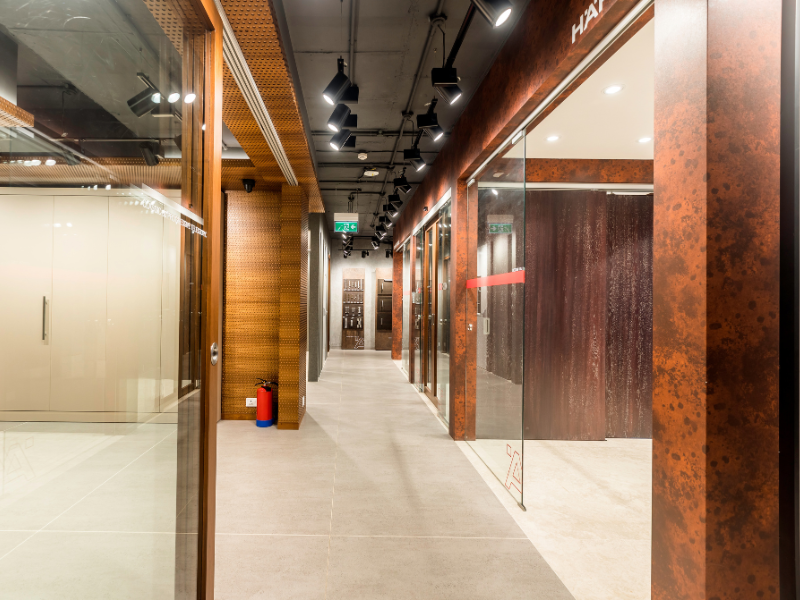
Interior Applications Where Fire Safety Is Non-Negotiable
In the overall building fire performance, facade safety usually takes the upper hand, but interior cladding also plays an important role. The air circulation is restricted in enclosed places which allows fire the opportunity to spread quickly, making the material selection process even more crucial. FR ACP is especially advised for interior spaces in:
- Hospitals and healthcare facilities, where evacuation involves patients with limited mobility.
- Airports and metro stations, where high footfall demands materials that do not contribute aggressively to fire spread.
- Shopping malls and commercial complexes, where enclosed atriums and corridors require safer cladding solutions.
- Educational institutions, where occupant safety is crucial.
- Corporate offices and high-rise lobbies, where fire compliance norms are increasingly strict.
Conclusion
In modern construction, material selection based on fire safety has become a core factor to consider. When you look at projects with requirements for high-rise facade or even interior applications, FR ACP from Aludecor delivers a balanced combination of safety, durability, and design flexibility. Compared to other standard LDPE-core panels available in the market, fire-retardant ACP from Aludecor offers measurable improvements in flame resistance, smoke suppression, and heat release control. This makes it a responsible and future-ready solution to use in varied projects. Besides, as building codes continue to change, the requirement for certified, performance-tested cladding systems will only increase. And that’s precisely why FR ACP remains a preferred material for safe facade and interior solutions for varied projects.
FAQs
Where is FR ACP mandatory in building design?
FR ACP is usually mandatory in high-rise buildings, commercial towers, hospitals, airports, and public infrastructure. These are spaces where fire safety regulations demand mineral-core, fire-retardant cladding materials.
How does FR ACP improve fire safety compared to standard ACP?
FR ACP uses a core that is mineral-filled. This significantly reduces flame spread, heat release, smoke density, and molten droplets which is unlike the standard LDPE-core ACP, which is completely combustible.
Is FR ACP heavier or harder to install?
FR ACP has a slightly higher density due to its mineral core, but it remains lightweight compared to traditional cladding materials. Besides, tt can also be fabricated and installed using methods that are used for the standard ACP sheets.
Does FR ACP cost significantly more than regular ACP?
FR ACP usually cost a little more than the standard ACP sheets because of its mineral core and fire-performance certifications. However, these sheets do come with the additional benefits of the long-term safety, compliance, and reduced risk exposure which justifies the investment, especially in high-rise and public buildings.