


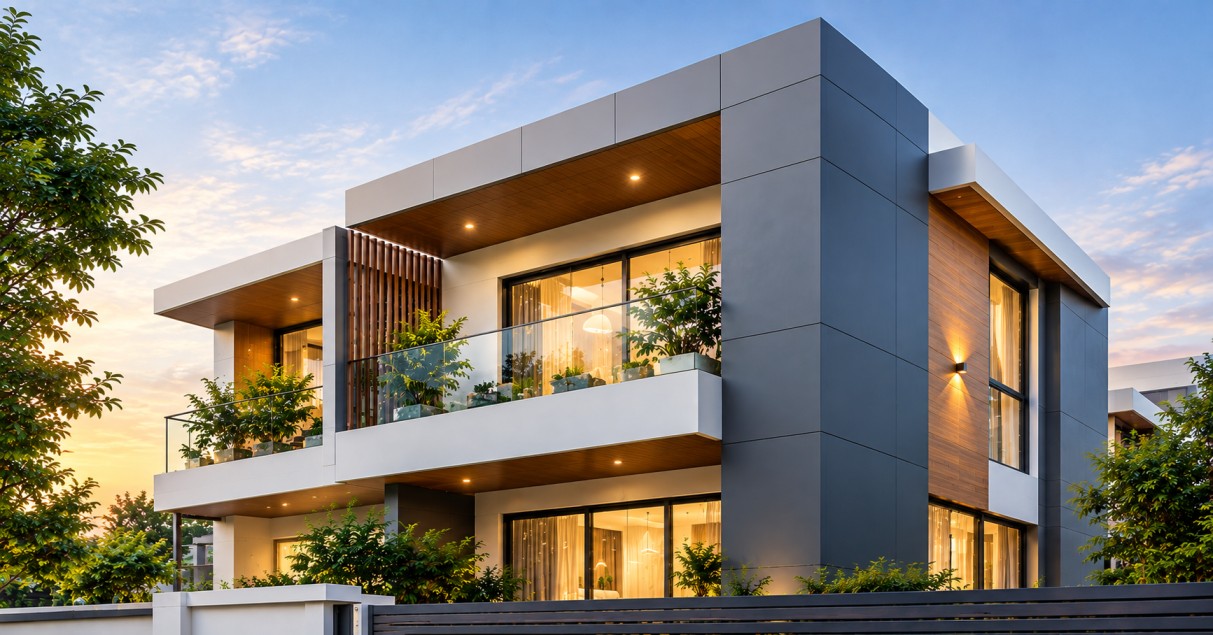
Homeowners are waking up to ACP for exterior and interior home applications, and the reason is more than just décor.
Paints, stones and tiles. While for many homeowners, the world might be confined within these, there is a fast-growing number of discerning residence owners who are waking up to aluminium composite panels as a preferred choice. Both for exterior and interior cladding. And for modular kitchen as well.
What started years ago as a smart consumer showing the way for the rest of the town gradually, is now a trend in itself. ACP is getting used for residences across India, widely in bungalows and even in apartments. Clearly consumers are becoming more aware of the advantages of using ACP over other products for certain applications. Designers too are beautifully leveraging the product’s complementarity with traditional materials.
So, an exterior residential facade with a heartwarming combination of ACP and stone is pretty much in vogue. So are ACP-clad balconies, soffits, canopies, cantilevers, balcony fascia and so on. ACP louvers – both corrugated and fin louvers – have become immensely popular as well, finding applications across the building envelope and fenced gates. The fin louvers are additionally used as shading devices. And not just exterior. ACPs, including louvers, have become a material of choice for interior applications as well, like false ceilings, feature walls, partitions, kitchen cabinets and more. ACP made modular kitchen is an industry in itself.

What explains this growing popularity of these surfaces? The answer lies in both function and form. The design flexibility of ACP makes it stand apart from the traditional materials. The smooth curves, corners and folds, the seamless appearance and the neat edges that can be achieved with ACP are easily unparalleled. Moreover, being way lighter than stone and other cladding materials, ACP adds much less dead load on the building, including the canopies and the balconies, proving to be an excellent choice for cantilevered designs apart from normal claddings.
High quality ACPs work as a protective skin to various elements of the building exterior, against the vagaries of nature and pollution. They retain their appearance for years, weeding out requirements of frequent repainting and renovation. Consumers not ready to compromise on their dream homes are found not to settle for anything less than the best. And many even go for much costlier composite panels of copper and zinc.
Aludecor’s ACPs, copper composite panels and zinc composite panels get recommended by architects to clients ready to go the whole hog to make their houses become a landmark. Surface Innovations like Wabi Sabi, Sand, the terrazzo-finish Granicia, Timber, concrete-finish Mason Mark, and the largest range of ACP louvers are some of the most popular Aludecor ranges in the residential space.
Call us at 1800 102 0407 or visit aludecor.com to explore ACP solutions for homes and long-term aesthetic value.
FAQs
1. Why is ACP becoming popular for residential buildings?
ACP is gaining popularity in residential buildings because it offers design flexibility, a lightweight construction solution and a wide range of colours, finishes and applications for both exterior and interior spaces.
2. Where can ACP be used in residential buildings?
ACP can be used for residential façades, balconies, soffits, canopies, cantilevers, balcony fascia, louvers, gates, feature walls, partitions, false ceilings and modular kitchen applications.
3. Is ACP suitable for residential exterior façades?
Yes. High-quality ACP can be used for exterior residential façades, providing a lightweight cladding surface that can complement materials such as stone, concrete and other architectural finishes.
4. What are the advantages of using ACP over traditional cladding materials?
ACP offers greater design flexibility, lighter weight and the ability to create smooth curves, folds, corners and seamless-looking surfaces. Its lower weight can also help reduce dead load compared with heavier cladding materials.
5. Can ACP be used for interior applications in homes?
Yes. ACP can be used for several interior applications, including feature walls, partitions, false ceilings and modular kitchen cabinets, allowing homeowners and designers to create coordinated interior and exterior designs.


