


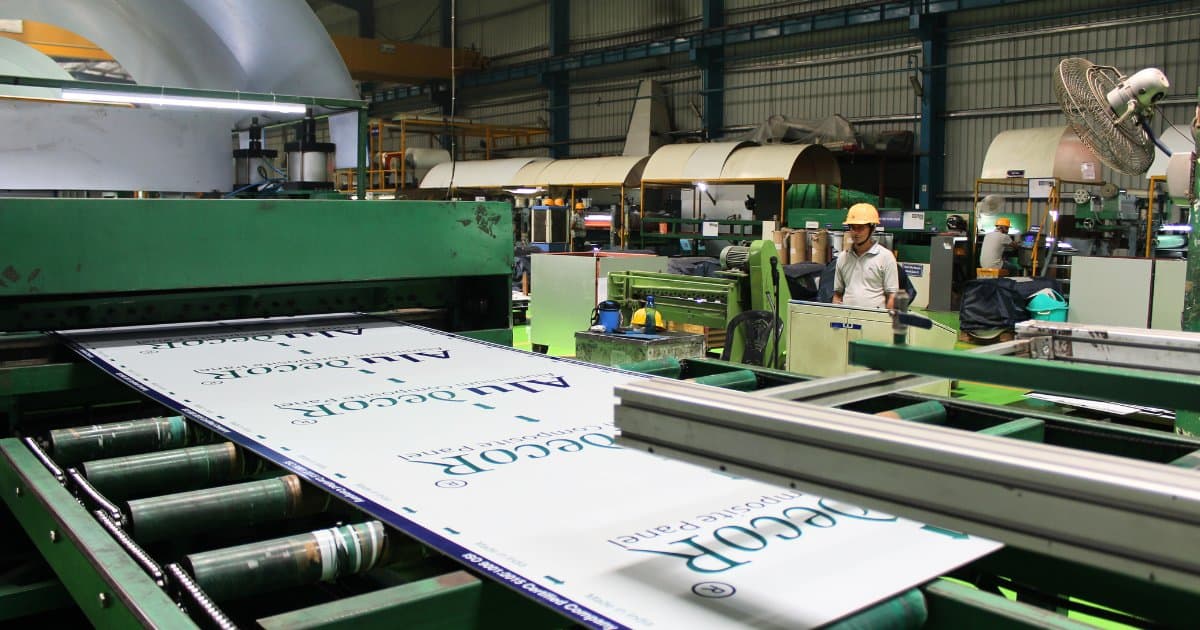
Ever wondered how Aluminium Composite Panels (ACP) achieve their precision, durability, and flawless finish that make them an architect’s top choice? The ACP sheet manufacturing process is a perfect blend of engineering precision, material science, and stringent quality control.
At the heart of this process is Aludecor recognized as India’s most tested and trusted ACP sheet manufacturer, NABL-accredited, and BIS-certified. With cutting-edge technology and advanced European equipment, Aludecor has set benchmarks in aluminium composite panel production, ensuring every panel meets global standards such as ASTM, EN, and NFPA. This article takes a deep dive into how ACP sheets are made from raw material preparation to final quality inspection, exploring both traditional and modern manufacturing methods that define excellence in today’s façade engineering.
-
What is an ACP Sheet?
An Aluminium Composite Panel (ACP) is a sandwich structure comprising two thin aluminium coils bonded to a non-aluminium core, typically made of a thermoplastic material such as LDPE (Low-Density Polyethylene) or Fire-Retardant (FR) mineral-filled core.
This combination delivers lightweight strength, flatness, and design flexibility, making ACP ideal for applications like building façades, signage, interior cladding, and corporate identity design.
-
Evolution of ACP Manufacturing: From Conventional to Contemporary
Traditional Manufacturing Methods
Early ACP production was largely manual or semi-automated, relying on batch lamination and basic coating techniques. Quality variations and limited production speed were common. The manual control of heat and pressure often led to uneven bonding, affecting long-term panel performance.
Modern Manufacturing Methods
Modern ACP production lines, like those operated by Aludecor, are fully automated and digitally monitored. They integrate PLC-controlled lamination systems, inline corona treatment, and AI-driven surface defect detection. This ensures uniform thickness, superior adhesion, and precision coating consistency hallmarks of a tested and certified ACP panel.

-
Step-by-Step ACP Sheet Manufacturing Process
Step 1: Raw Material Preparation
The process begins with sourcing high-grade aluminium coils and core materials. At Aludecor’s facilities, aluminium coils are pre-treated and degreased to remove any surface impurities that could affect coating adhesion. The core material LDPE or FR compound is compounded using state-of-the-art extrusion systems for uniform density and enhanced fire resistance.
Step 2: Coil Coating (Pre-Painting)
Before lamination, aluminium coils undergo continuous coil coating, a key differentiator between premium and ordinary ACP brands.
At Aludecor, multi-stage coating lines apply PVDF (Polyvinylidene Fluoride) or Polyester paints under strict climate-controlled conditions. These coatings are baked in high-temperature ovens (around 250°C) to ensure maximum adhesion, gloss retention, and UV resistance.
Why It Matters: Coil coating enhances corrosion resistance, ensures uniform color consistency, and contributes to the long lifespan of façades exposed to harsh Indian weather conditions.
Step 3: Core Extrusion and Lamination
This is the heart of the ACP sheet manufacturing process. The polyethylene or FR core is extruded as a molten layer and sandwiched between two pre-coated aluminium coils.
Using precision lamination rollers, the three layers are bonded under controlled heat (around 140–160°C) and pressure (15–20 tons). The result is a perfectly fused composite structure with superior mechanical strength and thermal stability.
Technical Insight: Aludecor’s seven advanced lamination lines ensure consistent panel bonding and eliminate delamination issues that often plague lower-grade panels.
Step 4: Cooling and Cutting
The laminated ACP sheet then passes through cooling chambers, allowing the bonded structure to stabilize. Once cooled, panels are trimmed and cut into standard dimensions—commonly 1220 mm × 2440 mm or customized as per project needs.
Laser-guided cutters ensure tight dimensional accuracy, which is crucial for modular façade systems.
Step 5: Quality Testing and Certification
Every batch of ACP panels undergoes rigorous quality testing before dispatch. At Aludecor’s NABL-accredited laboratory, panels are tested for:
- Peel strength (bond integrity)
- Coating adhesion and pencil hardness
- Weathering and UV resistance
- Fire-retardancy (as per ASTM E119, EN 13501-1, and NFPA 285)
- Mechanical properties (tensile strength, flexural rigidity, impact resistance)
Being a BIS-certified and internationally tested ACP brand, Aludecor ensures that every panel not only meets but exceeds Indian and European benchmarks for façade safety and performance.
Read also: Designing Coastal Buildings: How ACPs Withstand Salt, Wind & Humidity
Step 6: Surface Finishing and Packaging
Once quality clearance is obtained, panels are film-laminated for surface protection. Each panel is labeled with batch traceability data for accountability and transported using specialized packaging to prevent edge damage.
Modern finishes from metallics and woodgrains to stone and rustic textures are achieved using precision-coated films and nanocoating technologies for long-lasting aesthetics.

-
Why Certifications Like NABL and BIS Matter
When selecting ACP sheets, certifications are not just formalities they are proof of reliability and compliance.
- NABL accreditation validates in-house laboratory testing accuracy.
- BIS certification ensures conformity to Indian standards (IS 15658 for ACP).
- ASTM, EN, and NFPA tests confirm global performance readiness.
By achieving all these, Aludecor stands apart as India’s most tested and trusted ACP sheet manufacturer, offering tested and certified ACP panels trusted by architects nationwide.
- The Role of Innovation in ACP Manufacturing
As the construction industry embraces sustainability and digital fabrication, manufacturers are moving toward:
- Fire-retardant mineral cores (A2-s1,d0 and B-s1,d0 classifications)
- Smart coating systems for self-cleaning façades
- AI-integrated quality control
- Sustainable production practices with minimal VOC emissions
Aludecor, being a pioneer in aluminium composite panel production technologies, continues to lead this transformation through constant R&D and investment in environmentally responsible manufacturing.
The ACP sheet manufacturing process is more than a production line, it’s a commitment to quality, safety, and innovation. From precision coil coating to NABL-accredited testing, every layer represents trust built over decades. As India’s most tested and trusted ACP sheet manufacturer, Aludecor exemplifies what it means to blend engineering expertise with architectural aesthetics—creating panels that define the skyline of modern India.


