At Aludecor, we have always believed that the future of façade materials will not be defined only by aesthetics, durability, or fire performance. It will also be shaped by transparency. Today, architects, consultants, developers, and project owners want more than product claims. They want verified environmental impact data that helps them make better material decisions. That is why our Environmental Product Declarations published on EPD Hub and ECO Platform marks such an important milestone for us.
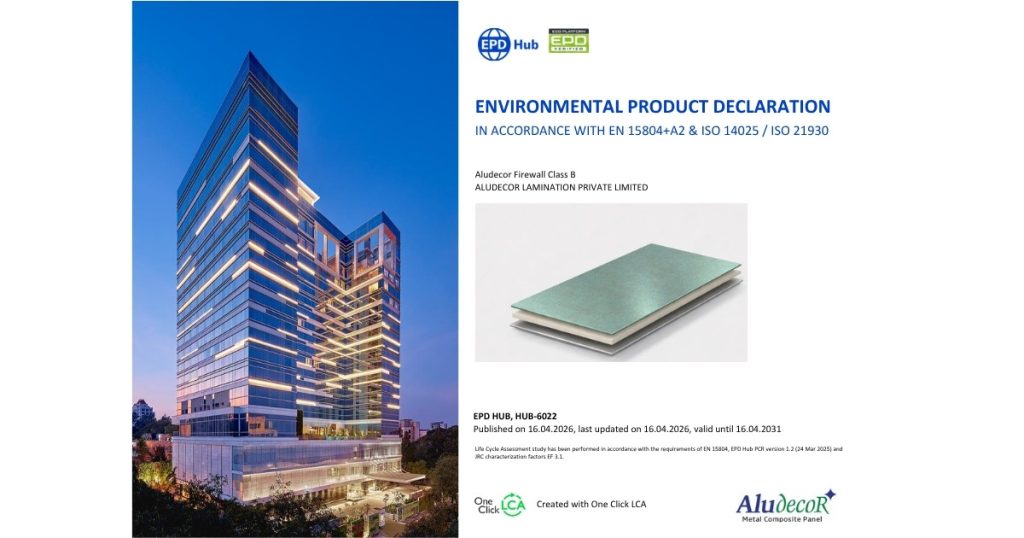
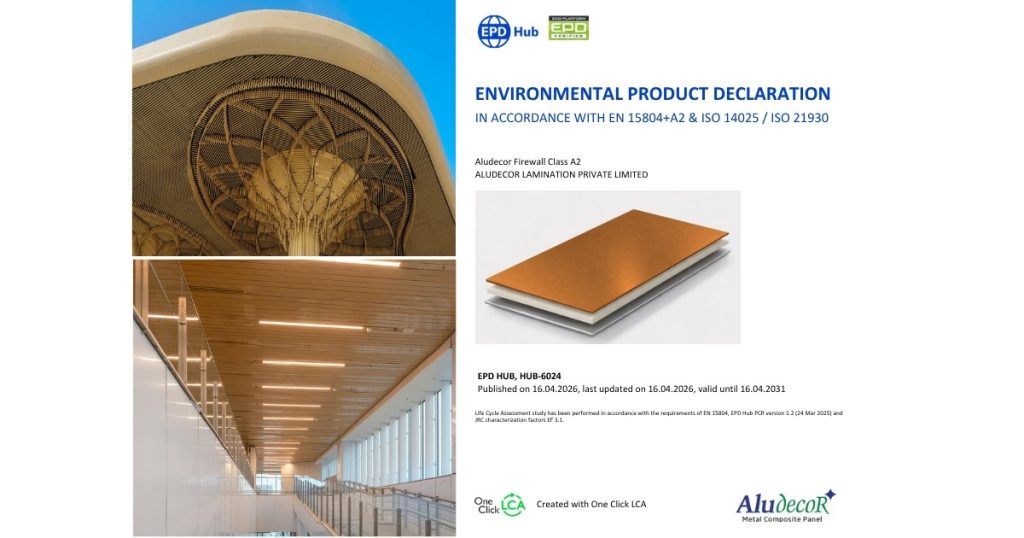
Our Aludecor Firewall Class A2 and Aludecor Firewall Class B are now backed by internationally verified Environmental Product Declarations bearing EPD Numbers HUB-6024 and HUB-6022 respectively. These declarations are published on EPD Hub & ECO Platform and carry validity of five years. They are independently verified and prepared in accordance with globally recognized standards including EN 15804+A2, ISO 14025, and ISO 21930.
For us, this is not just another certification. It is a powerful statement of intent. It reflects our commitment to bringing scientific, third-party verified environmental transparency into a product category that has traditionally been discussed more for performance than for measurable environmental disclosure. With this step, we are giving the market something more substantial than broad sustainability language. We are giving it data.
What an EPD really means
An Environmental Product Declaration, or EPD, is often described as the nutrition label of the construction industry. That comparison is apt. Just as a nutrition label tells you what is inside a food product, an EPD tells you the measured environmental impact of a construction material across its life cycle. It is based on Life Cycle Assessment methodology and looks at the impacts associated with raw materials, transport, manufacturing, transport to site, end-of-life stages, and recyclability benefits beyond the system boundary.
What matters most is that an EPD is not a marketing badge. It is not a “green” certificate in the casual sense. It does not exist to make vague claims about sustainability. It exists to provide independently verified facts. That distinction is important, especially in a market where specifiers are becoming increasingly careful about what they trust.
At Aludecor, we see this kind of transparency as essential to responsible specification. As projects become more focused on green building benchmarks, life cycle accountability, and ESG-linked procurement, product-level environmental data is becoming more relevant than ever.
Leave a Comment