


In contemporary construction, façade materials are evaluated not only for appearance but also for measurable performance. Among these parameters, ACP sheet durability plays a decisive role in determining long-term safety, aesthetics, and lifecycle costs. As one of India’s established ACP manufacturers, Aludecor has consistently emphasised structured testing as the foundation of material credibility. This approach underpins the positioning of India’s most tested and trusted ACP, where claims are supported by documented results rather than assumptions. For architects, fabricators, contractors, builders, dealers, and government bodies, understanding how quality tests translate into on-ground reliability is essential when selecting aluminium composite panels for diverse Indian conditions.
Overview of Aludecor’s ACP Quality Tests
Quality testing of aluminium composite panels is a multi-stage process that evaluates performance across mechanical, environmental, and safety parameters. At the core of this evaluation lies ACP sheet durability, which determines how a panel responds to stress, weather exposure, and time. Aludecor’s ACP quality testing process is aligned with relevant Indian and international standards to ensure consistency and repeatability.
The ACP quality testing process typically includes tests for coating adhesion, colour retention, impact resistance, peel strength, and fire behaviour. Each test addresses a specific risk associated with façade failure. For example, coating adhesion tests assess whether surface finishes can withstand thermal cycling, while peel strength tests evaluate the bond between aluminium skins and the core—an important factor for structural integrity.
By systematically analysing these parameters, the durability is measured through performance data rather than visual inspection alone. This structured methodology allows stakeholders to compare panels using verified benchmarks instead of surface-level similarities.
Durability Tests That Define Long-Term ACP Performance
Durability testing focuses on how an ACP behaves when subjected to conditions that simulate real-world use. These tests provide insight into material ageing, environmental interaction, and long-term stability.
Bond Strength and Delamination Resistance
One of the most critical contributors to ACP sheet durability is the strength of bonding between aluminium skins and the core. Peel strength tests evaluate this bond under standard conditions as well as after exposure to heat, boiling water, and freezing temperatures.
Consistent bond performance is essential during fabrication. Panels with weak or uneven adhesion may fail during routing, folding, or installation. This reinforces why fabricators should use tested ACP sheets, as validated bond strength reduces fabrication risks and limits the possibility of on-site failures.
Impact and Mechanical Stress Resistance
Impact resistance and tensile tests assess how panels respond to mechanical stress during handling, transportation, and service life. These tests simulate accidental impacts, wind pressure, and structural movement. Panels that meet defined thresholds demonstrate higher resistance to deformation and cracking, directly supporting long-term ACP sheet durability in demanding applications.
Weathering and UV Stability
Accelerated weathering tests simulate prolonged exposure to ultraviolet radiation, heat, and moisture. These evaluations help predict colour retention, gloss stability, and coating integrity over extended periods. In the Indian context—where intense sunlight and monsoon cycles coexist—weathering performance becomes a key indicator of ACP sheet durability.
Moisture, Humidity, and Chemical Resistance
Durability is also influenced by how ACPs respond to moisture ingress, humidity, and environmental chemicals. Tests involving boiling water immersion, humidity exposure, and chemical contact evaluate whether coatings and adhesive bonds remain stable under aggressive conditions.
These assessments are particularly relevant for coastal regions, industrial zones, and dense urban environments where moisture and pollution levels remain consistently high.

Why These Tests Matter for Dealers
Dealers act as a critical link between manufacturers and the construction ecosystem. Product failures, even when caused by inferior materials, often reflect back on dealer credibility.
Verified ACP sheet reduces uncertainty at the point of sale. When panels are supported by documented test results, discussions shift from price-based comparison to performance-based evaluation. This is especially relevant for institutional and government projects, where compliance, traceability, and accountability are mandatory.
From a commercial perspective, materials that have passed a structured ACP quality testing process are less likely to exhibit premature fading, delamination, or surface inconsistencies. For dealers, this translates into fewer disputes, reduced after-sales issues, and stronger long-term relationships.
Comparing Tested vs Untested ACP for Business Advantage
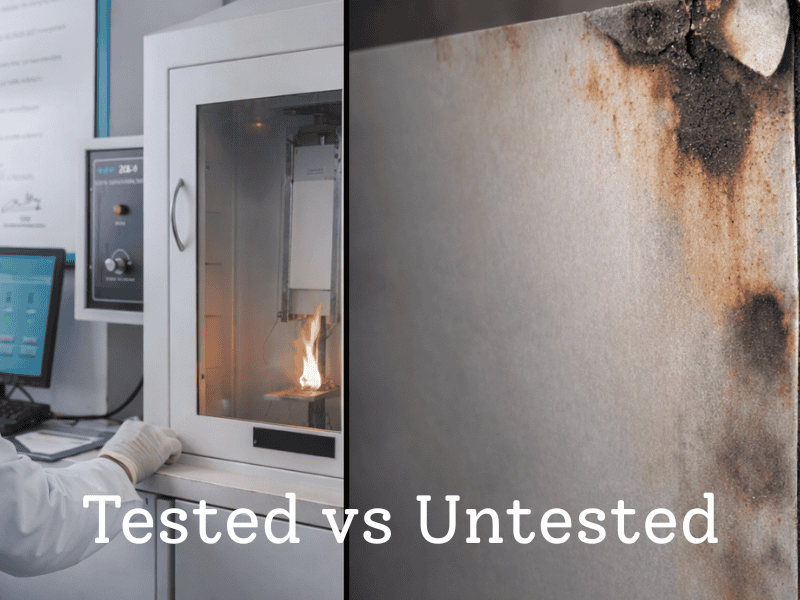
The difference between tested and untested ACP panels becomes evident over time. Untested panels may appear similar at installation but often underperform due to inconsistent raw materials or inadequate bonding, directly compromising the durability under real-world conditions.
Tested panels offer predictability. Results generated through the tests define how the panel will behave under specified conditions. This predictability becomes a tangible business advantage for both dealers and fabricators.
For fabrication-intensive projects, understanding why fabricators should use tested ACP sheets becomes especially relevant. Panels with verified peel strength, flatness, and mechanical consistency are easier to process, reducing material wastage and rework. Over multiple projects, this reliability contributes directly to operational efficiency.
India’s Most Tested and Trusted ACP in Real-World Applications
The emphasis on Aludecor, India’s most tested and trusted ACP reflects a broader industry shift towards accountability. Real-world applications demand materials capable of withstanding heat, humidity, pollution, and mechanical stress simultaneously.
Through repeated validation, ACP sheet durability becomes a measurable performance attribute rather than a marketing claim. Structured testing ensures that materials perform consistently across locations, climates, and project scales.
Tips for Dealers and Fabricators to Verify ACP Quality
Verification of panel quality does not require specialised equipment but does demand awareness. Requesting documented test reports is a fundamental step. These reports should clearly outline test standards, conditions, and outcomes defined within the ACP quality testing process.
Batch identification and traceability further strengthen confidence in material consistency. From a fabrication standpoint, recognising why fabricators should use tested ACP sheets also involves understanding how durability benchmarks influence machining, bending, and installation behaviour, leading to predictable workmanship and fewer site-level complications.
How is ACP sheet durability tested?
Testing involves mechanical, environmental, and safety evaluations. Panels are subjected to adhesion, impact, and weathering tests that simulate real-site conditions to assess long-term performance stability.
What is the ACP quality testing process for commercial projects?
The testing process for commercial projects includes assessments for coating performance, bond strength, and fire behaviour to verify compliance and reduce performance-related risks.
Why do fabricators prefer tested ACP sheets?
Fabricators prefer tested panels because they offer predictable behaviour during cutting, bending, and installation, reducing rework and ensuring consistent façade execution.
Conclusion
In a sector where material performance has direct safety and financial implications, testing serves as an objective measure of reliability. For dealers and fabricators, verified ACP sheet durability supports informed decision-making and long-term business confidence. By reinforcing structured evaluation, India’s most tested and trusted ACP, Aludecor demonstrates how documented performance can elevate industry standards. With advanced testing protocols and consistent validation, Aludecor continues to contribute to dependable façade solutions across India.