
Selecting façade materials today is not merely about colour or surface appeal. It is a technical decision. Architects, consultants and developers now evaluate structural stability, lifecycle cost, fabrication capability and long-term weather behaviour before finalising any cladding system.
One comparison that frequently surfaces in façade discussions is HPL sheet vs. ACP sheet. Both materials are widely used across exterior cladding, balcony panels, signage systems and architectural façades. Yet their internal structure, fabrication possibilities and environmental performance are quite different.
Let’s be honest. At first glance, a building finished with HPL and one clad with ACP may appear visually similar. But the material science behind them tells a very different story. Traditional HPL panels are dense laminated boards produced under extremely high pressure. ACP panels, meanwhile, are engineered composite structures designed specifically for architectural cladding. And when a 6 MM ACP sheet enters the comparison, the discussion becomes even more interesting.
This guide breaks down the real differences between HPL sheet vs ACP sheet, focusing on practical factors such as material composition, weight, durability, design flexibility and cost considerations.
What is a Traditional HPL Sheet?
High-pressure laminate, or HPL, is a decorative structural panel produced by compressing multiple layers of kraft paper impregnated with thermosetting resins.
The manufacturing process generally involves:
- Stacking layers of kraft paper
- Impregnating them with phenolic resin
- Adding a decorative top layer
- Pressing the layers under high pressure, often exceeding 70–100 bar
- Heating them at temperatures between 140°C and 160°C
The result is a dense laminate board with good surface hardness and moderate structural rigidity.
Traditional HPL sheets are commonly used in:
- Balcony cladding panels
- Decorative façade sections
- Interior wall cladding
- Washroom cubicles
- Furniture surfaces
But here’s something industry professionals quickly recognise when discussing an ACP sheet vs HPL sheet. HPL is essentially a compressed laminate board. It does not contain metal layers or engineered cores that support advanced fabrication. Exterior grade HPL panels are usually available in thicknesses ranging from 6 mm to 8 mm and are installed using mechanical fasteners such as rivets or screws attached to aluminium subframes.
They perform well in certain applications. But their rigid structure limits bending, routing and shaping possibilities.
Also Read: Universal Quartz: Designing an Industrial Landmark That Stands Apart
What is a 6 MM ACP Sheet?
A 6 MM ACP sheet is an engineered aluminium composite panel developed specifically for architectural cladding systems.
Its structure typically consists of three layers:
- A top aluminium skin
- A core layer made of mineral-filled or polymer composite
- A bottom aluminium skin
The aluminium skins provide structural strength while the core layer maintains thickness and reduces weight.
For façade grade panels, aluminium skins can reach 0.5 mm thickness, creating strong yet lightweight cladding panels. Coating systems applied to the aluminium surface often range between 30 to 50 micron thickness, enhancing durability and colour stability.
A 6 MM ACP sheet is widely used in:
- Commercial building façades
- Airports and metro stations
- Corporate offices
- Hospitals and educational campuses
- Architectural signage
When industry professionals evaluate ACP vs HPL sheet, one thing becomes clear rather quickly. ACP panels are engineered systems designed for façade performance, not merely decorative surfaces.
And that difference significantly affects durability, installation efficiency and design possibilities.
A Detailed Comparison Of HPL Sheet Vs 6 MM ACP Sheet
Understanding hpl sheet vs acp sheet requires looking beyond surface appearance. Professionals compare several parameters before selecting façade materials.
ACP Sheet Vs HPL Sheet comparison table:
| Parameter | Traditional HPL Sheet | 6 MM ACP Sheet |
| Material Type | High-pressure laminate made from resin-bonded kraft paper | Aluminium composite panel with aluminium skins and core |
| Typical Thickness | 6–8 mm | 6 mm |
| Weight | Heavier due to a solid laminate structure | Lightweight composite structure |
| Fabrication | Limited cutting and drilling | Routing, bending and folding are possible |
| Installation | Mechanical fastening | Cassette and rainscreen systems |
| Design Options | Laminate textures such as wood or stone | Metallic, textured and customised architectural finishes |
| Maintenance | Periodic inspection required | Easy cleaning and low maintenance |
Now let’s explore each factor in more detail.
Material Composition
The most fundamental difference in hpl sheet vs acp sheet lies in their composition.
| Factor | HPL Sheet | ACP Sheet |
| Core Material | Resin-impregnated kraft paper layers | Mineral or polymer composite core |
| Outer Surface | Decorative laminate layer | Aluminium skins with architectural coatings |
| Structural Behaviour | Solid laminate board | Engineered composite structure |
This layered aluminium construction allows ACP panels to achieve greater strength with lower weight.
When discussing the ACP sheet vs. the HPL sheet, this structural engineering difference becomes crucial for façade systems.
Thickness & Weight
Although both materials may appear similar in thickness, their weight varies significantly.
| Factor | HPL Sheet | 6 MM ACP Sheet |
| Typical Thickness | 6–8 mm | 6 mm |
| Panel Density | High-density laminate | Lightweight composite |
| Structural Load | Higher load on façade framework | Lower structural load |
Lower panel weight improves installation efficiency and reduces load on building structures. Which is why many façade engineers favour ACP when evaluating ACP vs. HPL sheet.
Durability & Lifespan
Durability is another major factor in HPL sheet vs. ACP sheet comparisons.
| Factor | HPL Sheet | ACP Sheet |
| UV Stability | Moderate | High with advanced coatings |
| Surface Protection | Laminate surface | Architectural coating systems |
| Lifespan | Dependent on the environment and sealing | Designed for long-term exterior use |
ACP panels use advanced coating systems between 30 and 50 microns that help maintain colour stability and weather resistance.
Weather Resistance
Exterior façade materials must withstand extreme weather conditions, including rainfall, UV exposure and temperature variation.
| Factor | HPL Sheet | ACP Sheet |
| Moisture Resistance | Moderate | Excellent due to aluminium skins |
| UV Resistance | Moderate | High with architectural coatings |
| Corrosion Resistance | Limited | Aluminium provides natural corrosion resistance |
ACP panels are often used within ventilated rainscreen façade systems, allowing airflow behind the cladding surface and reducing moisture accumulation.
This improves building envelope performance when evaluating Acp sheet vs Hpl sheet.
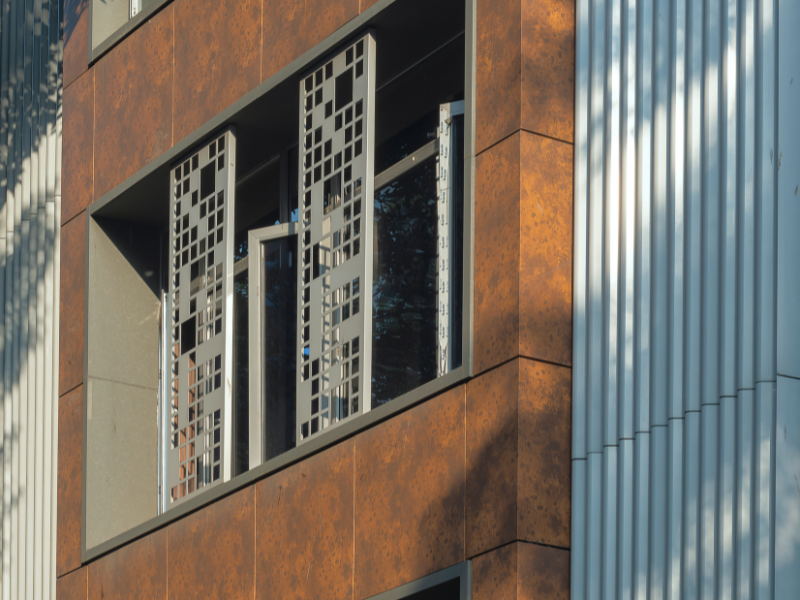
Design & Aesthetic Flexibility
Design freedom is where ACP panels clearly outperform traditional laminate boards.
| Factor | HPL Sheet | ACP Sheet |
| Curving Ability | Limited | Possible through routing and bending |
| Panel Fabrication | Straight cutting only | Folding and cassette fabrication |
| Design Range | Decorative laminates | Metallic, textured and architectural finishes |
ACP panels can be fabricated into curves, angles and seamless façade elements. This flexibility allows architects to create distinctive building forms.
Which is why discussions around ACP vs. HPL sheet often favour ACP for contemporary architecture.
Maintenance Needs
Maintenance is a practical factor often overlooked during material selection.
| Factor | HPL Sheet | ACP Sheet |
| Cleaning | Requires regular inspection | Easy water washing |
| Surface Behaviour | Laminate may attract dust | Smooth coated surface |
| Long-term Upkeep | Moderate maintenance | Low maintenance |
ACP panels are easier to maintain because of their coated aluminium surfaces.
Cost Considerations
Cost evaluation should always consider lifecycle performance rather than just purchase price.
| Factor | HPL Sheet | ACP Sheet |
| Initial Cost | Sometimes lower | Moderate, depending on grade |
| Installation Cost | Higher labour effort | Faster installation |
| Lifecycle Cost | May increase due to maintenance | Lower long-term maintenance |
In many commercial projects, professionals analysing hpl sheet vs acp sheet ultimately consider the full lifecycle cost of the façade system.
How Industry Professionals Use Them – Both materials have their place in construction.
Traditional HPL sheets are commonly used for:
- Balcony partitions
- Decorative panels
- Interior wall cladding
- Furniture surfaces
ACP panels are widely used for:
- Large-scale building façades
- Corporate offices
- Airports and metro stations
- Retail storefronts
- Architectural signage systems
From our experience, ACP panels offer superior design flexibility and façade performance. We manufacture aluminium composite panels using high-quality aluminium alloys and advanced coating technologies to ensure durability and structural reliability for architectural projects.
Choosing the Right Material for Modern Façades
The debate between the HPL sheet and the ACP sheet ultimately depends on project requirements.
Traditional HPL sheets are suitable for decorative panels and certain exterior elements where structural complexity is minimal.
But modern architecture often demands materials that combine durability, flexibility and long-term weather resistance. ACP panels fulfil these requirements through their engineered composite structure, lightweight behaviour and advanced coating technologies.
And as building design continues to evolve, façade materials must adapt accordingly. ACP panels allow architects to create expressive, durable and efficient building envelopes while maintaining aesthetic versatility.
Contact our expert team today at 1800-102-0407 or visit aludecor.com/enquiry to request a consultation and explore façade solutions tailored for your next architectural project.
Also Read: PVDF Coating vs FEVE Coating on ACP Sheets: What You Should Know
FAQs
Which material is easier to install, HPL or ACP?
ACP panels are generally easier to install. Their lightweight composite structure allows faster handling during façade installation. ACP panels can also be fabricated into cassette systems that fit seamlessly into façade frameworks. HPL sheets are solid laminate boards and therefore heavier. Installation usually requires mechanical fasteners such as screws or rivets attached to structural frames, which can increase installation effort.
Can both HPL and 6 MM ACP sheets be used for exterior applications?
Yes. Both materials can be used in exterior environments, but their performance characteristics differ. HPL sheets are commonly used for balcony cladding and decorative exterior panels. 6 MM ACP sheets are specifically engineered for façade applications. Their aluminium skins and protective coatings provide strong resistance to UV exposure, rainfall and atmospheric pollutants.
Do both materials offer design flexibility?
Both materials offer decorative surface options. However, ACP panels provide far greater fabrication flexibility. HPL sheets are typically installed as flat panels. ACP panels can be routed, bent and folded to create curved façades, cassette systems and complex architectural shapes. This fabrication capability allows architects to explore more creative façade designs.