


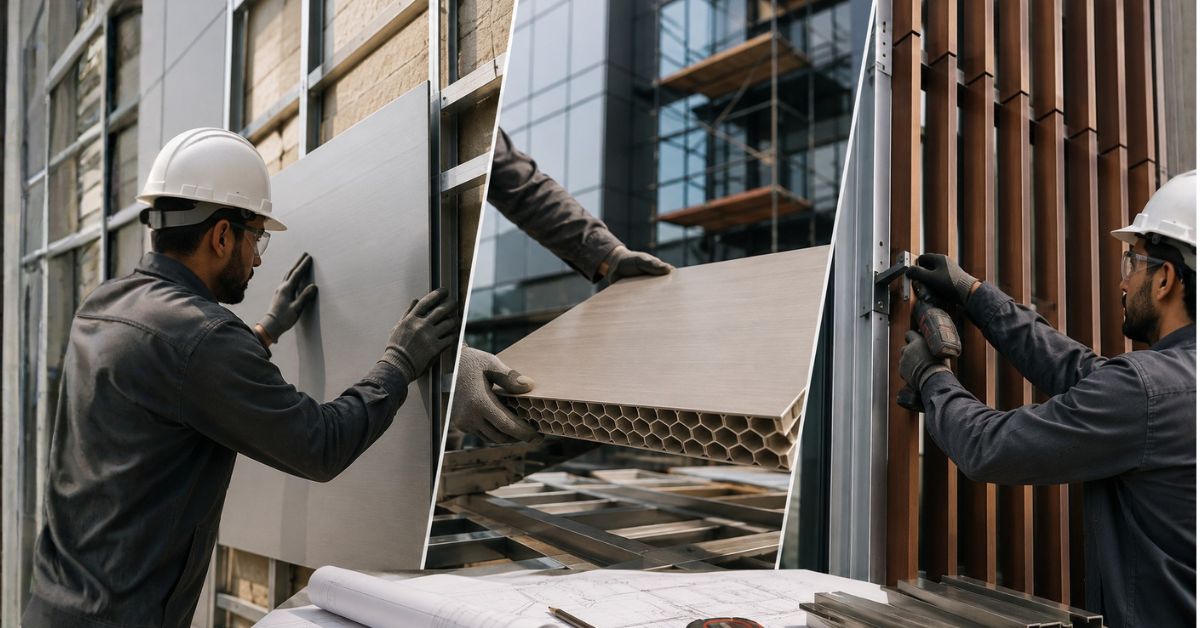
Let’s be honest. If you’ve been fabricating facades for a few years, you already sense the shift. Clients aren’t just asking for flat panels on simple elevations anymore. The real work, the well-paying, reputation-building kind, now involves aluminium honeycomb panels, motorised louver systems, and cladding assemblies that demand a completely different skill level.
Today, when a fabricator steps on site, they are not just installing cladding. They are executing a performance system. Fire safety, wind load resistance, thermal behaviour, and precision alignment all come into play and suddenly, a simple ACP sheet installation guide doesn’t feel enough anymore. In fact, most experienced fabricators realise that following an ACP sheet installation guide today means going beyond basics into system-level understanding.
The real shift is this. The industry is no longer rewarding effort alone. It is rewarding understanding. And the difference between staying relevant and getting left behind often comes down to how quickly you adapt to advanced systems.
Why the Facade Industry in India Is Evolving Faster Than Ever
Airport expansions, metro stations, tech parks, luxury hospitality projects. India’s commercial construction sector is demanding facades that perform thermally, resist fire, handle wind loads, and look extraordinary simultaneously.
The standard acp vs advance acp conversation used to be simple. Budget projects got standard panels, premium ones got better. That binary is collapsing. Even mid-tier commercial buildings in Tier 2 cities now specify aluminium honeycomb panels and external louver arrays.
Ashish Parakh, a respected voice in facade engineering, puts it plainly. In Tier 2 and Tier 3 cities, developers and contractors are only beginning to encounter advanced materials. Awareness takes time to build. But the shift has already begun, sometimes driven by regulatory mandates, sometimes by end clients demanding safer buildings, and increasingly by developers who recognise safety and performance as genuine selling points. Material innovation is pushing the industry forward. Honeycomb panels, fire-retardant ACP systems, and factory-engineered louvers are no longer niche products. They are becoming mainstream in premium and even mid-scale projects. As highlighted in the industry discussion, innovation today is not just about how a building looks. It is about how efficiently and safely it performs.
We at Aludecor have seen this first hand. Fabricator queries have shifted dramatically from colour options to fire classifications, thermal performance values, and fixing system compatibility. That tells you everything. This shift is exactly why a modern ACP sheet installation guide now includes performance parameters, not just fixing methods.
Also Read: How Aludecor’s ACP Quality Tests Help Dealers and Fabricators Choose the Right Sheets
The Difference Between Installing Standard ACP and Advanced Cladding Systems
There was a time when ACP sheet installation guide was largely a repetitive, process-driven job. You followed a sequence, worked with familiar tools, and managed site adjustments as they came. It was skill-based, yes, but predictable.
Nexcomb honeycomb panels, the sandwich construction includes a pre-coated aluminium facing skin, adhesive layer, NexCore honeycomb core, another adhesive layer, and a back skin. The panel achieves Class A2-s1, d0 fire classification per EN 13501-1. Non-combustible, zero flaming droplets, negligible smoke. But that performance only holds with correct installation using the right fixing system and proper sub-frame tolerances. In the standard acp vs advance acp comparison, this is exactly where advanced systems demand deeper technical understanding.
“The biggest technical advantage I see in honeycomb panels is that they are lightweight and fire resistant. That combination makes them one of the most promising façade materials today.” — Ashish Parakh
Watch the full conversation here: Ashish Parakh, MD, Glazium Facades | Honeycomb Panels, Louvers & Upskilling Fabricators
With standard panels, a millimetre here or there rarely causes functional failure. With advanced systems, improper installation can compromise structural integrity and void warranties. That distinction matters enormously. Below is the standard ACP vs advanced ACP difference.
| Parameter | Standard ACP Installation | Advanced Cladding Systems |
|---|---|---|
| System Complexity | Simple tray panels | Engineered systems |
| Tolerance | Moderate | Very tight (±1–2 mm) |
| Skill Level | Basic | High precision + technical understanding |
| Error Handling | Adjustable on site | Errors are costly and visible |
| Substructure Role | Important | Critical |
Key Skills Every Fabricator Needs to Work With Honeycomb Panels
First, understand the panel construction, It is different from an ACP sheet Installation guide. Nexcomb panels use facing skins of 0.7 mm top and 0.5 mm bottom, with NexCore made from AA3003, H-18 grade aluminium alloy. Cell sizes range from 2 mm to 19 mm, each offering different strength-to-weight profiles. Knowing which specification suits which application is foundational, not optional. This is where an advanced ACP sheet installation guide becomes critical, because system selection directly impacts performance
Second, master the fixing systems. Aludecor has developed five systems for Nexcomb: Uni-Lock, M-Lock, Edge-Lock, Interlock, and Zenith-Lock. Zenith-Lock is exclusively for ceilings. Interlock handles partitions and interior cladding. Uni-Lock, M-Lock, and Edge-Lock serve facade applications. Mixing these up is one of the costliest mistakes fabricators make.
Third, respect flatness tolerances. Nexcomb’s exceptional surface flatness comes from our fully automated roll-forming facility in Haridwar. A warped sub-frame transfers stress into the panel face, and on a large facade that’s visible from the street.
As Ashish Parakh rightly points out, every material has its own method of fabrication and installation. When a new product enters the market, fabricators must first learn the correct techniques to handle and install it. Without proper understanding, even the best materials fail to deliver their intended performance. And that’s on us as an industry to fix.
Also Read: How Aluminium Honeycomb Panels Make Installation and Maintenance Hassle-Free
Installing Louvers Correctly: Common Mistakes and How to Avoid Them
Louvers may look simple, but they are one of the most performance-sensitive façade elements. Their role goes beyond aesthetics. They control sunlight, improve ventilation, and contribute to thermal comfort.
What has changed significantly is the move towards factory-finished systems. These systems arrive ready to install, reducing site work and improving consistency.
“If you receive a finished product that is ready to install, it saves enormous time on site. Today, time is money, and factory-finished systems always perform better.” – Ashish Parakh
However, installation mistakes are still common, and they can affect both performance and appearance.
Some key issues to watch out for include:
- Incorrect angle fixing affecting shading efficiency
- Misalignment of fins disrupting visual uniformity
- Weak anchoring in high wind areas
- Ignoring expansion gaps
A good fabricator doesn’t just install louvers. They understand how the system behaves in real conditions. And that level of understanding often comes from going beyond a basic ACP sheet installation guide into system-specific training.
Training resources, workshops, and certifications available in India
Structured training for facade fabricators in India is improving. Aludecor runs product-specific sessions covering Nexcomb and Alubreeze installation methodology. If you work with our products and haven’t attended, you’re leaving knowledge on the table.
Parakh also acknowledges the growing role of digital tools. Platforms like MATGenie, Aludecor’s AI-powered material guide, bring product knowledge, technical insights, and guidance into a single interface. In an industry where information is often scattered across different sources, a centralised knowledge platform helps professionals make genuinely informed decisions.
And here’s the business case for upskilling that nobody says loudly enough. Fabricators who specialise in advanced systems command better margins. A contractor who understands honeycomb panel fixing systems, can read solar shading calculations, and handles motorised louver assemblies confidently is competing in a completely different market. Better projects, better clients, better budgets.
Build a portfolio of completed advanced installations with proper documentation. Before and after photographs, fixing system details, product specifications used. That portfolio becomes your most powerful sales tool when pitching ambitious projects.
How to Grow Your Business by Specialising in High-Performance Facade Products
If you’re still focusing only on basic ACP work, you’ve probably noticed how competitive it has become. Margins are tight, and differentiation is difficult.
But the moment you step into advanced systems, everything changes. Clients start valuing expertise. Consultants start recommending specialists. And your role evolves from contractor to solution provider.
Understanding standard acp vs advance acp is not just a technical upgrade. It is a business strategy. The standard acp vs advance acp shift is what separates commodity work from specialised execution.
Fabricators who are growing today are focusing on:
- Fire-retardant ACP systems
- Honeycomb panel installations
- Factory-finished louver systems
- Complex façade geometries
And over time, something shifts. You stop competing on price. You start competing on capability. Fabricators who truly understand standard acp vs advance acp positioning are the ones moving into higher-value projects.
The Future Belongs to the Fabricator Who Never Stops Learning
The materials available to Indian fabricators today are genuinely world-class. Aluminium honeycomb panels with Class A2 fire ratings. Motorised louver systems with Wi-Fi smart control. Roller-coated fins in 30° and 45° configurations. That’s not marketing. That’s where the technology has arrived.
Parakh frames it well. The future of facade construction lies at the intersection of innovation, education, and responsibility. Advanced materials open new possibilities, but their true potential is only realised when fabricators are equipped with the knowledge to use them correctly.
A proper ACP sheet installation guide approach means understanding not just the how, but the why. Because a complete ACP sheet installation guide today is less about instructions and more about informed decision-making. Why this fixing system. Why this fin angle. Why this fire classification matters for this building height.
Isn’t that what being genuinely good at your job actually means?
Call us at 1800-102-0407 or visit aludecor.com/enquiry to explore ACP solutions designed for performance and long-term aesthetic value.
FAQs
How do I become a facade fabricator in India?
Start with hands-on experience at an established fabrication company. Learn standard ACP installation first, then progress to advanced systems. Attend product-specific training from manufacturers like Aludecor, and build working knowledge of wind load considerations and fixing system selection.
What is the installation process for aluminium honeycomb panels?
Select the correct fixing system first. Cassette and non-cassette panels use Uni-Lock. J-Type panels use M-Lock and Edge-Lock. Ceiling installations use Zenith-Lock exclusively. Install the sub-frame to tight tolerances and follow the ACP sheet installation guide to maintain the panel’s certified Class A2-s1, d0 fire performance.
How are ACP louvers fixed to a building exterior?
Alubreeze louvers use aluminium brackets, channels, and press plates specified by fin width and angle. Press plates run at 2 pieces per linear metre. For 30° fins, a U Bracket 30° and Angle Fixing Bracket are both required. Component quantities increase in high wind load zones.
What makes honeycomb panels easier to design with?
Panel thickness ranges from 6 mm to 100 mm with curved radii from 300 mm to 2,000 mm. At just 5.2 kg/m² for a 10 mm panel, Nexcomb reduces structural load significantly. Custom cell sizes from 3 mm to 19 mm allow tailored strength profiles. Factory-finished with PVDF or FEVE coatings, panels arrive ready to fix.
Are honeycomb panels good for fire safety?
Yes. Nexcomb panels achieve Class A2-s1, d0 per EN 13501-1. Non-combustible, zero flaming droplets, negligible smoke. The NexCore hexagonal structure also physically slows fire spread compared to wood or MDF honeycomb alternatives, providing additional evacuation time in a fire event.


